Whisper it but are trophies becoming important again?


January, of all months, truly is tediously formulaic. Even by the standards of a system designed to order the nebulous concept of time into 12 repeatable fragments, each corresponding to a set point of our orbit around the sun, and the specific conditions that each entails, it is ridiculous. You know exactly what you’re going to get from January.
Particularly when it comes to the conversation around football. With the torrent of that-was-the-year-that-was think-pieces, calendar-year expected-assist stats, and pearl-clutching about the congested festive fixture schedule out of the way, January is about a few key things. Half-termly reports. Hypothetical transfers that won’t happen. The gearing up of top four pushes and relegation scraps. And, most predictably, the following nine words: the magic of the cup is alive and well.
In recent years, these words have felt somewhat hollow and disingenuous. Typically lobbed arbitrarily about in the Final Score studio as some plucky upstarts from the lower reaches earn a replay against a lower-mid-table Premier League side’s reserves, they have, really, meant something quite different. Namely, that the magic of the cup is not that alive and not that well, and is actually under distinct threat. The relentless repetition of the opposite – usually supported by talk of the oldest cup competition in the world, and always with some mention of Ronnie Radford – is in many ways the equivalent of standing in front of the mirror, telling that flabby pasty thing staring back at you that this, contrary to all available evidence, is going to be his year. It is no less than wilful self-deception.
Obviously, this is only true up to a point. Nobody can deny that Lincoln City’s 2017 run to the quarter-final, for instance, or Newport County’s famous victory against Leicester, were lovely to see. For supporters of lower-league clubs to get these rare moments of national, televised glory, is a thing to be cherished. Full stop.
Yet, given the diminutive size of these clubs, we are statistically pretty unlikely to have had any skin in these games. And for us, the wider football-consuming public, the spectacle of these giant-killings, whilst nice and fuzzy-feeling, has undeniably been diminished by the attitude of the bigger clubs to the competition itself. Back in 2019, Newport beat a Leicester midfield of Matty James and Hamza Choudhury. Leicester’s goal was scored by Rachid Ghezzal. Yes, the gulf was still enormous, but some of the so-called magic has to be diluted by the simple conclusion that if Leicester’s strongest side plays, they win.

What has necessitated the incessant reminders of the magic of the cup is that the past two-and-a-bit decades have seen a gradual decline in its lustre. Perhaps due to the influx of foreign managers with less emotional attachment, and certainly due to the vastly overblown financial rewards on offer for existence in the Premier League and qualification for Europe, priorities for those towards the top of the English game have changed. League position is everything. The FA Cup is a quaint side-project for most, an inconvenient distraction for many.
This weekend just past, however, felt different. Maybe not for all, and definitely with varying degrees, but there was an inescapable sense that this mattered. That the old competition may well be rediscovering some of its lost vitality. That, dare we say, the magic of the cup is, if not wholly alive and well, then coming back to life a little.
For confirmation, you need not only look to Meadow Park or Aggborough, but also to Premier League grounds up and down the country. Moments like Amari Morgan-Smith’s completely imperceptible winner for Kidderminster against Reading would have sent the crowd into raptures, and given us the dressing-room soundbites and feelgood stories that we crave, whatever the year and however under-strength the opposition. But what imbues that particular moment with greater significance in the wider context is what was going on at the London Stadium, at Stamford Bridge, at Molineux, or at St. James’ Park. Because the integrity and essential value of sporting competition is wholly reliant on the regard in which it is generally held. And here, there are encouraging signs.
Whilst many of the Championship sides – such as Reading themselves – rested numerous players ahead of gruelling Saturday-Tuesday schedules over the coming weeks, almost all Premier League sides took the occasion seriously. West Ham made only three changes for their tie with Leeds. Chelsea started with Kovacic, Werner and Lukaku against Chesterfield. Arsenal did give Eddie Nketiah his customary cup run-out, but he was supported by the Martinelli-Saka-Ødegaard triumvirate that has propelled them to fourth in the table; and, what is more, it was against lower-league opposition.
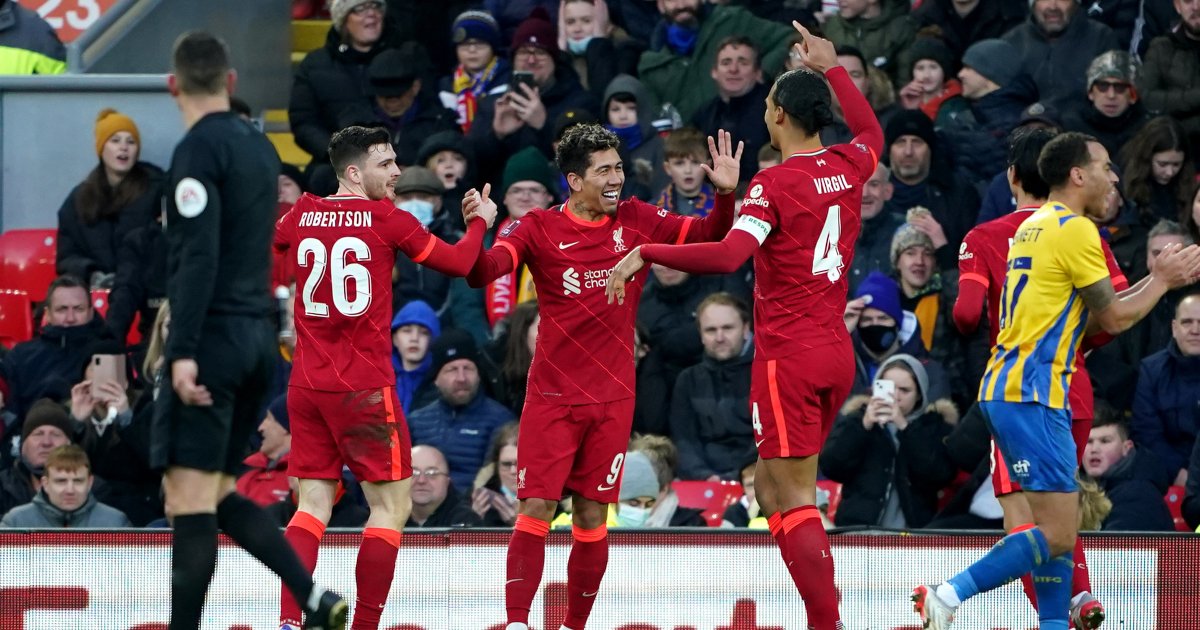
Even Liverpool – who under Jurgen Klopp have never progressed beyond the fifth round and have been taken to replays by Plymouth, Exeter and their opponents on Sunday, Shrewsbury – named a strong-ish side. Yes, their starting XI had an almost Serie A-esque combined squad number of 457, which is indeed suggestive of a little rotation, but this is a squad allegedly ravaged by Covid, and a starting line-up that still featured Virgil van Dijk, Andy Robertson, Ibrahima Konaté and Fabinho.
And they played in front of a full house. As did Newcastle in their glorious loss to Cambridge. As did West Ham. And Man United. Spurs and Chelsea had crowds of 40,000 for the visits of Morecombe and Chesterfield, respectively. This wasn’t across the board, and there were some half-empty grounds. But to hear the roar as Harry Kane scored a rudimentary third to finally sink a team 21st in League One, or the chorus of boos that greeted the final whistle at St. James’, was to be left with the distinct impression that, to supporters, the FA Cup holds real value.
Of course, much of this can be explained by the pandemic. Last year’s weird, skeletal ghost-ball thing left so many bereft of the essential pleasure of seeing their team play, there is a certain truth to the notion that these are people just glad to get their fix, whatever that fix is. True, also, is that many clubs sensibly lowered ticket prices to boost attendances. But while it is often the fans who set the mood music around a club, they also follow it too. If your club visibly cares about a competition, so do you. And in many ways, the seemingly increased supporter interest is symptomatic of a wider trend within the game.
More accurate, perhaps, is to call it a reversion. Back to fusty old values, like competing for trophies is a good thing. And whilst this has obviously always been the case, it has felt for some time that many clubs had forgotten it, content either – depending on their objectives – simply to survive or to ensure European qualification, and keep the pennies rolling in. Now, as the higher echelons grow more used to the astronomical figures in the game, and recalibrate their expectations accordingly, they are perhaps remembering the actual point of all this: at least trying to compete for the competitions that you have entered.
Football is a symbiotic system. Everything about it, its importance or otherwise, is the result of innumerable, interconnected values, perceptions, ideas and opinions. Jadon Sancho cost £75million because enough people said that he did, on the basis of what he himself had done and what others thought about it. How good a player or manager, how successful a career once it is done, is decided upon by the court of public opinion. So, too, the weight afforded to their achievements, their victories, the trophies they have won.
And while Pep and Mourinho were derided for their comments about the Community Shield being a major trophy, and the Phil-Foden-is-better-than-Leeds-because-he’s-won-twenty-Carabao-cups banter draws its irony from the fact that it is not an esteemed competition, both point to a slight sea change in the way trophies are perceived. To those such as Guardiola, at the sharpest edge of the game, all silverware is worth something. And this, as with all footballing perceptions, filters down.
Just look at the time afforded to Mikel Arteta, with an FA Cup winner’s medal secured, and that not given to Mauricio Pochettino or Ole Gunnar Solskjaer with their empty cabinets. Clearly, this was not the only factor in either case, but it does feel like more of a factor than it maybe was in the recent past. And this, for the FA Cup and our enjoyment of it, and to make mention of its magic that little bit less formulaic and that little bit more genuine, is a very good thing indeed.
Ed Capstick – follow him on the Twitter