16 Conclusions from Arsenal 2-2 Man City: Haaland, Havertz, hair-pulling, housery, howlers and handball
What an absolutely sensational slab of Barclays that was, right up until greedy, sh*tty old VAR once again decided it simply had to have the last laugh.
Arsenal v Man City was absolutely everything you could want from a big game between big beasts. The perfect blend of quality, errors, controversy, antipathy and, well, everything. Until that ruinous final act where controversy ensured it would have the biggest, perhaps only, piece of the pie.
1. Usually, when any football conversation begins with “A shame that…” you can be absolutely certain that it was not in fact a shame. It’s usually the precursor to some kind of “Scenes nobody wants to see” reality-denial. Indeed, we got a slice of that today when at half-time, the pundits were all in agreement that we didn’t want to see any red cards spoiling the spectacle here.
What guff! We were absolutely up for some red cards! Spectacle-enhancing red cards! Especially for Bruno Guimaraes, but especially for Enzo Fernandez!
But in the end, it really does feel like an actual genuine shame that one of the most wonderful slices of Throwback Barclays – a game that was for 95 minutes full of just the most perfect blend of quality, mistakes, housery and sheer breakneck pace that it reminded you how much fun football can be – will mostly be remembered for an all-time bottle job from VA-f*cking-R. Really, can it not just f*ck off? Everything it touches just turns to sh*t.
2. Sigh. We couldn’t just enjoy it, could we? Couldn’t just enjoy two heavyweights standing and trading lusty but only occasionally connecting blows amid a veritable cornucopia of entertaining side-quest nonsense. It was just such a wonderfully enjoyable game of football, right up until the VAR official – we haven’t checked which fool it was in there today, but we assume it was Mr. Buzz Killington – decided to once again make it all about them with a staggering non-decision.
But we’re getting ahead of ourselves. Let’s first of all give credit where it’s due. Big players step up in the biggest moments of the biggest games, and Viktor Gyokeres produced a stunning save in the final minute of injury time to preserve the point Arsenal had scrapped so hard for over the previous 95 minutes of chaos.
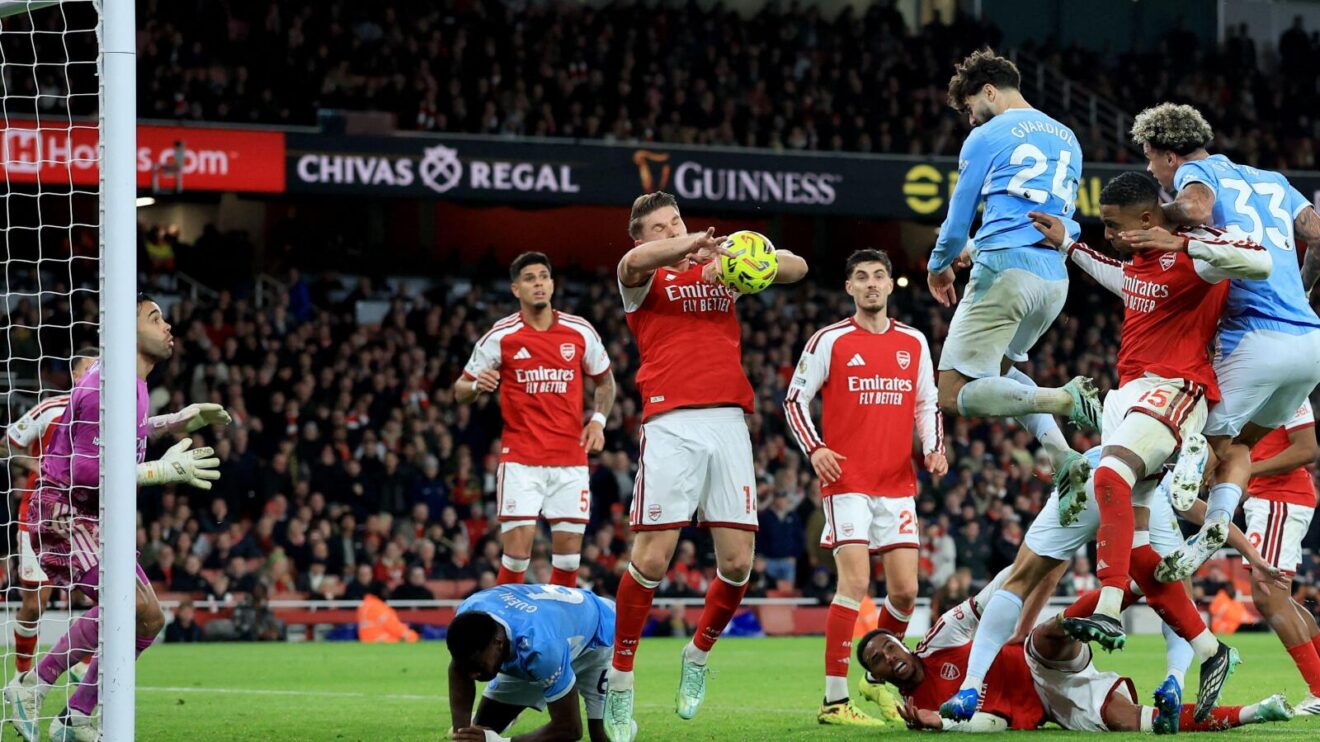
Alas, the problem is that Gyokeres is, at least nominally, a striker rather than a goalkeeper. And thus, according to the stuffy old laws of association football, not actually allowed to make vital point-preserving saves in the final minute of added time.
Maybe VAR had it right after all. Maybe it was just such a great save at such a vital moment that it was worth just ignoring the laws of the game altogether in order to preserve its magic.
It must have been their thinking, because the actual reasoning provided for not giving the most straightforward penalty imaginable was pure nonsense. We can think of two possible scenarios in which the VAR’s conclusion that Gyokeres’ arms were, as he thrust them away from his body towards the ball and in so doing directly prevented Josko Gvardiol’s header from going in the goal, in ‘a natural position’ would apply. But we don’t think Gyokeres is in fact either a zombie or a T-rex.
3. Until that moment, though, what a wonderful spectacle it had been. This was liquid Barclays.
The first three goals were all wonderfully done.
The fourth one was everything the late penalty fiasco wasn’t: exactly the right amount of controversial, i.e. not really that controversial at all because it actually could go either way, to keep us all entertained and allow the content machine to go brrrr for the next couple of days while ramping up the previously established tension between two teams who genuinely dislike each other, and had delivered the perfect game to demonstrate just how much they genuinely dislike each other.
That – along with assorted nonsense about hair-pulls that might or might not have been hair-pulls that might or might not have, according to ancient playground laws, revealed that many Arsenal players fancy Jeremy Doku, or possible second yellows, or questionable delays to first yellows – was exactly the kind of stuff we wanted to see. And exactly the kind of thing that would usually and wrongly fall under the ‘Shame to see’ umbrella from conclusion one.
4. To understand Arsenal’s second equaliser, all you need to know is that Micah Richards thought it was definitely a foul on Gianluigi Donnarumma, and Ian Wright thought it definitely wasn’t.
For what it’s worth, we’re definitely closer to the Wright camp than the Richards one. We wouldn’t have been at all surprised to see it disallowed, because Goalkeepers Are A Protected Species, Aren’t They? But we’d have been a bit annoyed.
It was a goal that owed far more to desperately weak goalkeeping from Donnarumma than Gabriel nudging him in the back of his head with an elbow, while himself also being pushed by Marc Guehi.
The subsequent genuine honker of a decision ought, you’d imagine, have quietened the noise around the less clear-cut nature of this one, but it seems to have had the opposite effect. They’ve been bundled together as two huge new pieces of evidence in the definitely-very-real Pro-Arsenal Conspiracy that has now replaced the previous and equally definitely not-made-up Anti-Arsenal Conspiracy with which English football has so adroitly kept us all on our toes over the last decade.
We’re not having it. Had that been overturned and City go on to win 2-1 we think consensus would have crystallised around a ‘Game’s gone’ agreement that it was all just a bit soft and perhaps even utter woke nonsense to allow gentle giant Donnarumma to get away with such a weak effort.
We can’t quite agree with Wright’s view that different rules should and do apply to goalkeepers who are very large – Donnarumma seemed to grown an inch every time Wright responded to Richards – but in this instance we’re happy to say we think the right decision was reached. And also that Donnarumma really is being exposed on an almost weekly basis in Our League as a big fraud who has built an astonishing career on the back of being 16 years old once. We’re really just not convinced he’s actually very good.
5. Let’s go all the way back to the beginning. Because the big news started coming in this one before the game even began. The Arsenal team news giveth and the Arsenal team news taketh away, with David Raya fit to start in goal but Declan Rice not part of the matchday squad.
That second bombshell feels like something that was both rapidly overtaken by the sheer quantity of events taking place on the pitch, but also in and of itself a massive reason why there was such a sheer quantity of events taking place on the pitch.
It’s deeply unusual to see Arsenal without Declan Rice, and especially so in a game of this heft. And for large parts of the afternoon it wasn’t pretty for Arsenal, with both Bruno Guimaraes and Mikel Merino enduring extremely difficult afternoons in opposition to Elliot Anderson, Ayyoub Bouaddi and Enzo Fernandez.
6. Guimaraes, Merino and Fernandez appeared at times to be engaged in their own separate private little mini-game to see who could commit the most yellow-card offences without collecting more that one.
Guimaraes was so proficient that it felt entirely apt when his booking arrived still inside the first half yet described as ‘finally’ by the commentators. Both Merino and Fernandez had been carded by then, with Fernandez having been fortunate to escape an early one for a daft dive when he seemed more interested in trying to get Bruno in trouble than a potential shooting chance, and Merino perhaps more fortunate still to escape unscathed from one of those classic ‘definite first yellow but not always a second’ fouls.
While those three turned the midfield contest into chaos, the calmness and efficiency in the absence of Rice was provided almost exclusively by Anderson, who has stepped up admirably after moving to City at what has to be considered an inopportune time.
In the space of his first dozen Premier League games for City, he has been named man of the match at Old Trafford, Anfield and the Emirates. It’s not bad, is it?
Yet the overriding story of the midfield battle was still mainly to be reminded precisely why it’s so very, very unusual to see Arsenal play a big game – or indeed any game – without Rice in there and thus why he was required to become the world’s weariest footballer before the World Cup.
7. Guimaraes’ yellow card at the very end of the first half continues a remarkable record for him against Manchester City.
This was his ninth Premier League game against City. He has been booked in eight of them, with five of those bookings coming before half-time.
In all, he has now played 792 minutes of Premier League football against City, and spent 368 of those minutes nervously yet successfully walking the Disciplinary Tightrope.
8. The game began at breakneck speed with both teams seemingly fuelled by antipathy and loathing. It was great. Surely the game cannot continue at this absurd pace, one thought. It can, came the reply inside your head in Mick McCarthy’s voice.
The stats suggested Arsenal were on top in the opening half-hour, but the eye test told a different story. Arsenal were having more possession, more territory and more actual shots, but it felt like it was City who were creating the better moments without necessarily making the best of them.
And then, suddenly, they made the best of one. And it really did feel like it had been coming. Jurrien Timber suffered the twin humbling of giving the ball away initially before being nutmegged during Josko Gvardiol’s brilliant run, which ended with the composure to find the pass to pick out Erling Haaland, who was quick enough and just about accurate enough to get his right-footed shot away and beat Raya despite the keeper getting a decent piece of it diving to his left.
Impossible nevertheless to avoid the mischievous question: was Raya impeded at all by that injured left shoulder?
9. Arsenal’s response was emphatic, though, and they were level before the break after an expertly worked goal of their own. Noni Madueke robbed Enzo Fernandez who, having succeeded in getting himself booked for errant nonsense or other earlier in the piece, was unable to commit the obviously necessary and thoroughly on-brand cynical foul to bring an end to the imminent danger.
Madueke was able to work the ball to Christos Tzolis, whose deep cross was brilliantly cushioned back across goal by a flying Merino for an also-flying Kai Havertz to head home. In a game where Merino was something approaching a liability in the actual midfield role he was assigned, this was a reminder of how wonderfully effective he can be in myriad ways in the opposition box.
10. By half-time, it was already time for changes. If one wanted to glibly and over-simplistically summarise the efforts of the two managers in this game, it would be thus: Mikel Arteta got his initial team selection wrong, but gradually corrected it with his substitutions, while Enzo Maresca got his initial team selection right, and gradually eroded it with his substitutions.
The first change came at half-time, with Riccardo Calafiori replaced after getting a booking and a torrid at the hands of Iliman Ndiaye throughout a first half whose equal we cannot recall in his thus far largely stellar Arsenal career. It was a bleak 45 minutes spent almost exclusively looking second best.
Calafiori could have few complaints about getting the hook, but he might have looked across the pitch at, say, Merino and Timber and asked, if not necessarily “Why me?”, then certainly at least “Why not them?”
Even at 1-1, Arsenal entered the second half with a great deal of problems in need of a solution.
11. And it was a list that would grow longer still within minutes. It was another wonderful City goal, containing many of the same ingredients as the first but a wholly different cast of characters. Ayyoub Bouaddi was the man to win the ball with aggressive intent and then surge forward before finding a perfectly weighted pass. Enzo Fernandez, briefly taking time out from his role as the sh*thouse’s sh*thouse, made a flawless run from midfield to apply a deft and precise finishing touch.
It was a truly lovely piece of business. The run and finish from Fernandez were exemplary, while Bouaddi’s pass would have failed had it carried a smidge more or a hint less pace.
For all that flowing and rapid precision, though, questions can be asked of how quickly (or otherwise) Bruno Guimaraes sought to get back and help snuff out the threat and how quickly (or otherwise) Gabriel get across to try and cover off the run of Fernandez.
12. That task was made easier here by City gradually retreating into themselves after going back in front so early in the second half.
It was a disappointing response from Maresca, who appeared at the hour mark to be on course to Get The Big Games Right yet again. City’s attempt to play as much of this game on the front foot as possible was bold and not without risk, but it had got them into a position where they deservedly led an out-of-sorts Arsenal.
Continuing the attack-is-the-best-form-of-defence theme with pursuit of a third goal certainly seemed like City’s best course of action at this point, but they slowly but surely ceded both territory and latent counter-attacking threat.
Nico O’Reilly and Phil Foden came on midway through the half for Fernandez and Jeremy Doku. Neither O’Reilly or Foden could be considered negative, attack-shy footballers, but their introduction for two of City’s liveliest contributors going forward had a deadening effect.
The introduction of 10 minutes late of Mateo Kovacic for Ndiaye was straightforwardly and obviously negative, removing the last vestige of meaningful counter-attacking potential and allowing Arsenal to more confidently commit to what were by this point becoming waves of attack with a growing sense of inevitability about them. And we all know how that turned out.
13. Arsenal, meanwhile, were far better after a trio of something approaching sh*t-or-bust changes from Arteta just before the hour mark. Gyokeres, Eberechi Eze and Myles Lewis-Skelly replaced Martin Odegaard, Merino and Tzolis and changed the flow of the game in Arsenal’s favour.
Arsenal’s best spell of the game followed their introduction and, as is always in these situations, it’s up to each of us individually to decide how we balance the award of credit for recognising and correcting mistakes and how much we criticise the making of those mistakes in the first place.
For what it’s worth here, the only one of those calls you could reasonably argue Arteta could and should have made from the start is Lewis-Skelly in place of Merino. Lewis-Skelly’s greater mobility and technical ability in doing actual midfielding just feel like they were what Arsenal needed and lacked in the absence of Rice here.
14. There might have been no need for controversial equalisers or late penalty shenanigans had Gyokeres been able to finish his dinner. Maybe he was simply playing 4D chess to lay the groundwork for the fact he was in fact a goalkeeper rather than a striker all along in the two huge missed chances he produced in quick succession after stepping off the bench.
But it does feel like it’s far more likely he’s just not really an elite finisher. His first miss was a close-range header against the post and was uncomfortably similar to a glaring miss he had in the midweek 1-1 draw against Borussia Dortmund.
The second was even worse, barely making any contact at all when wonderfully placed with the goal at his mercy as the cross came in.
15. Even without the penalty incident, to step back and take in the wider view here is to think Arsenal have rather got away with a sticky couple of games. It’s not often as league leaders you can fail to win two games in a row and have neither of your closest rivals close the gap, with Man City also managing only two draws and Brighton not even that after a pair of chastening and momentum-killing defeats.
The very real sense remains that Arsenal are not yet really anywhere near playing their very best or even most effective football. Yet here they are, six points clear after a dozen games and doing very nicely thank you.
For all the craziness we saw across the 90-plus minutes of riotous entertainment and ultimate controversy, the state of play at the final whistle was the same as before the first: Arsenal with a very comfy lead and looking overwhelmingly likely to successfully defend the Premier League title for the first time.