Why ridiculous Premier League TV money makes it so attractive to investors
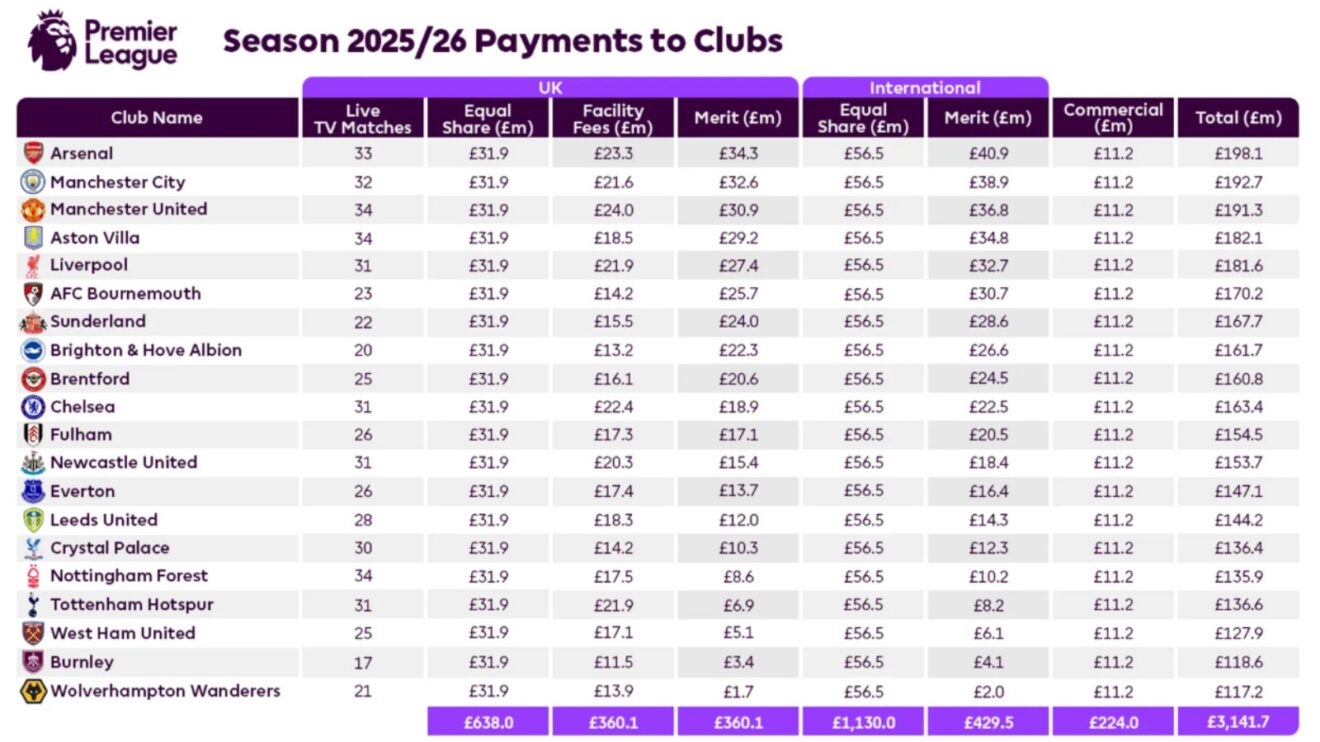
Earlier this week, the Premier League published how much each of its clubs made from the television broadcast revenues centrally distributed by the league. The figures illustrate why the Premier League – as well as the lower echelons of English football – remain so attractive to investors.
The amounts received by the Premier League’s top teams are, unsurprisingly, eye-watering. Champions Arsenal received almost £200m of the £3.14 billion distributed by the Premier League.
The more interesting figure however is the amount which the league’s worst teams netted. Wolverhampton Wanderers still received £117.2m from the league, despite finishing bottom and enduring a season where their relegation was all but confirmed by February.
To put Wolves’ broadcast income in context, £117m is more than the top teams in either the Bundesliga or Serie A made in equivalent revenue – the worst club in the Premier League earns more money than the best in Germany and Italy.
In part, this is a consequence of the Premier League broadcast deal being so much greater than its competitors. The £3billion paid out to top-flight English teams is almost three times the amount paid out to teams in La Liga, the league with the second-highest broadcast deal after the Premier League.
But, more interestingly, it is also a consequence of the Premier League having a more equitable system for distributing broadcast monies. Each Premier League club in 2025/26 was guaranteed to receive £99.6m as a guaranteed share, regardless of where they finished in the league. That equal share accounts for almost two thirds of all payments made by the league.
The result is a remarkably flat distribution of revenues – and stands in stark contrast to the rest of Europe. In Germany, Bayern Munich earned 2.7x more from broadcast money than the bottom placed Bundesliga team. Real Madrid received €157.9m of broadcast money in Spain, almost four times the €40m paid to Las Palmas.
In England, however, Arsenal only earned 1.7x more from TV broadcast money than 20th-placed Wolves.
This is an extremely significant factor for investors looking at football clubs, and partly explains the continued interest in England as a market despite spiralling losses.
The first reason is downside protection. When an investor buys a football club, the biggest risk is that results go badly and revenue collapses with them. In most leagues, the gap between the top and the bottom of the table is enormous, so a bad season is very expensive. In the Premier League, a bad season is still extraordinarily lucrative. A club that finishes 20th will still earn more from its league than almost any club on the continent. In other words, the floor is so high that the worst-case scenario looks like most other leagues’ best case.
The second reason is that most of the guaranteed money is not tied to the size of the club’s brand. Elsewhere, a large part of the distribution is linked to audience size, stadium attendance and historical success, which locks in the advantage of the giants.
Serie A, for example, pays out 22% of its money based on a club’s ‘social roots’ – mainly TV audiences and stadium attendances – and 28% based on sporting results, including results stretching back decades. A newly-promoted Premier League club, by contrast, gets the same £99.6m as Manchester City from day one.
Sunderland, in their first season back in the top flight, earned £167.7m by finishing seventh – more than Chelsea.
That is why, for a buyer, a mid-table or even struggling Premier League club can be a more attractive proposition than a club competing for titles elsewhere. The revenue base is larger, it is more predictable, and much of it is guaranteed.
Of course, none of this is a secret. Sellers know exactly how much their clubs receive from the league, and the guaranteed income is reflected in the asking price. Premier League clubs cost far more to buy than clubs of similar standing in Germany, Italy or France. A buyer is paying for that floor upfront. Equally, English clubs are losing money on an annual basis at a faster rate than most with 94% of teams found to be loss-making by the Independent Football Regulator.
Regardless, the comparison illustrates why the Premier League continues to attract more investors than any other league in world football. Just getting to the Premier League is so transformative to a club’s revenue base and enterprise value, that English football remains a more attractive bet than other markets for many football investors.
Insight Eleven is a boutique M&A advisory firm specialising in football club transactions. You can follow them on LinkedIn here and see their website here.