Premier League manager rankings: Will Pochettino, Frank or anyone else ever knock Carrick off his perch?
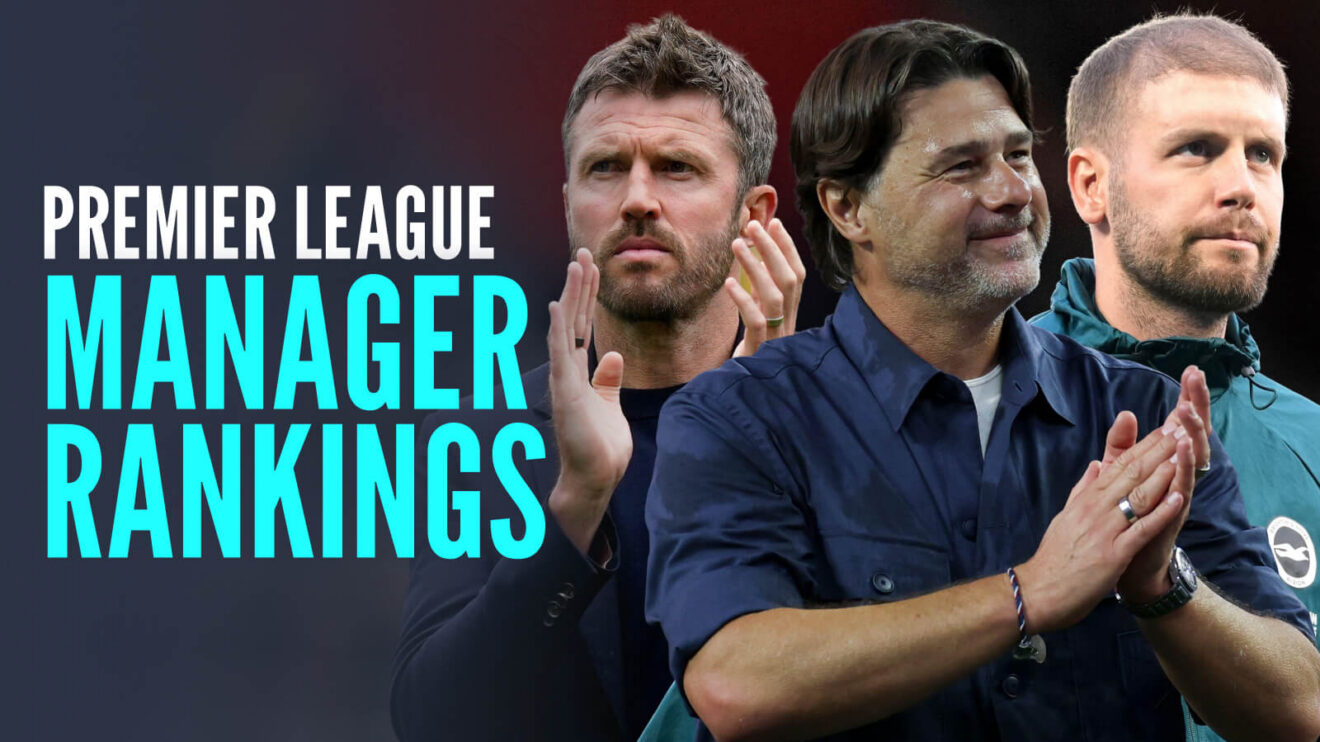
The November international break finally saw the agonisingly long wait for a Premier League managerial casualty come to an end – and then we got two of them for being so good and so patient.
Some would say we should have had our fill in a summer that saw nine managerial changes among the Premier League clubs, but to that we say tish and fipsy. More. We demand more. We will always demand more.
Although even we will concede that Tottenham’s Roberto De Zerbi being appointed in March and now finding himself in the top half of longest-serving current Premier League managers might be a bit much. Especially as one of the 10 below him have changed managers twice in that time.
But those changes mean we’re already up to 22 names in the manager rankings, and it’s always good fun to put a number against a manager before they’ve even taken charge of a single game. Should be obvious when you read on, but essentially Pochettino and Frank for now sit in the hinterland between the managers we think have done broadly okay and those who have engaged in notable bed-sh*tting to greater or lesser degree.
September’s rankings are in brackets, and you can read the whole thing here if you really want.
22) Michael Carrick (Manchester United, August-November) (20)
Never in the post-Ferguson Banter Era has a Manchester United manager been so overtly not the biggest problem. Never in the post-Ferguson Banter Era has a Manchester United manager been so obviously not a plausible solution.
The deeper question the United brains trust must now attempt to unravel is whether, indeed, such a solution-providing manager even exists.
Or whether, gasp, it might be time to consider their own roles in all this. To ponder for just the briefest moment such questions as ‘Is it really entirely necessary for what is perhaps the second largest football club on the planet, the club of Busby and Ferguson, to hand untrammelled power to erstwhile Blackburn and Leeds winger Jason Wilcox?’
Or ‘Is being someone who used to play football for this enormous club enough to override the absence of pretty much any relevant managerial experience for the scale of this role? Again?’ Or ‘Should we maybe do something about the roof, because if absolutely nothing else as a metaphor it’s just a bit too on the nose?’ Or ‘What even is a Christopher Vivell?’
They won’t waste time on these great imponderables, though. No. They are great and powerful people, far too busy for such trivial musings.
They have sacked Michael Carrick, and it is fair enough. They will not consider long their own parts in the fiasco, and it will not be fair enough. They have appointed a new manager in Mauricio Pochettino, and that might be okay.
We do at least know that Pochettino has proof of concept in continuing to deliver eye-catching results despite being hamstrung by owners who won’t or can’t fund the first team properly while trying to build an outlandish new stadium.
Can Pochettino succeed at United? Who knows. But he’s an upgrade on Michael Carrick and at this stage that is already enough.
Stirring comebacks from two goals down are all well and good but the thing with stirring comebacks from two goals down is that they are largely quite unsustainable as an approach and do also require you to keep going two goals down. “Look, the players are making catastrophic system and individual errors, but at least they haven’t downed tools altogether” is just too low a bar to be acceptable.
Manchester United could be six points better off than they are and still enduring an unacceptable start. This is, as we all know, Manchester United Football Club We’re Talking About.
The brutal reality is that it’s no real surprise that it’s happened again for United. That a decent sort rightly beloved in these parts for their storied playing career has come in as an interim manager, overachieved thanks to a heady brew of good vibes, not being the previous idiot, club DNA and the necessary luck that everyone needs to get on in life, before it all unravels once the commitment is made permanent.
And this time it’s happened so much faster than it did with Ole at the wheel. Which is understandable, really. Carrick is even less experienced, even less qualified, and with even bleaker resources at his disposal.
Carrick isn’t the first underqualified Knows The Club appointment to run into trouble after a honeymoon period carried along by the desperate unifying desire of everyone to make it work because it would be neat.
But he faced a particularly challenging task because as a player he looked kind of perfect for management in some ways, yet also entirely ill-suited in others. He read the game like a coach. He was yer classic ‘manager on the field’, a midfield string-puller who could be entirely relied upon to make all the right calls at all the right times to calmly and unfussily and almost imperceptibly bend games the way United desired.
Yet Carrick the man always seemed too quiet, too unassuming and, yes, maybe even just too bloody nice for big-time management. When Sky Sports News rocks up at Carrington to get some emergency footage from training against the backdrop of whatever disaster or humiliation ritual has just occurred, Carrick often looks like a competition winner. Standing, smiling, watching. Not apparently doing an awful lot of coaching.
Such snapshots means nothing, of course, and nobody wants managers to performatively affect a persona that just isn’t them. But it’s mirrored by just how small and quiet he looks on the touchline as whatever the latest calamity to unfold unfolds.
It’s not true that there is only one specific personality that can make this job work. But it does feel like it needs a particularly big one. Ruben Amorim, for all his many other faults, had that. Erik Ten Hag did not. And Carrick does not.
It would be entirely unfair to completely dismiss what Carrick achieved in those interim months. United really were excellent in those closing months of the season and deservedly finished third in the league. Even now, they sit fifth in the 2026 table. That third-place effort was very much a best-of-the-rest finish, but given the mess he took over, it was no small accomplishment.
And one-game-a-week easy mode isn’t a guarantee of success. Neither Xabi Alonso nor Roberto De Zerbi are currently doing with a similarly light schedule what Carrick pulled off last season. But he was still on easy mode, by the standards of TIMUFCWTA.
It was a penalty kick for Carrick. One game a week for five months. If he failed, nobody would blame him. But if he succeeded…
And succeed he did, before being let down in the summer as United searched out cut-price deals and scoured the proverbial bargain bins.
We had our doubts and fears in the summer, but we can’t honestly say we thought it was going to end with ‘in the relegation zone after winning one Premier League game at the November international break’ but we wouldn’t have been that surprised at the significance of ‘November international break’.
It’s not you, Michael, it’s them. But it is also you, a bit.
21) Pierre Sage (Crystal Palace, August-November) (17)
Farewell, Pierre, we hardly knew ye.
It’s a real shame this went so rapidly sideways, because it was without doubt among the more interesting of the flurry of summer appointments that almost half the clubs in the Premier League made through either choice or necessity.
Following Oliver Glasner was never going to be easy for anyone, but Palace did appear to have identified a likely sort in a man who had performed just the kind of big-boy-bothering overachievement in France that would be just the ticket for Palace.
Unfortunately, and maybe this is just the language barrier, he didn’t appear to know, understand or care for the word ‘defend’. Palace under Sage’s watchful eye effectively abandoned all pretence of even attempting what most football watchers do agree is quite an important part of the game.
First of all, it’s obviously fair to note that Palace have lost some quite handy defenders in the last couple of windows. Any team of Palace’s standing is likely to struggle a bit when losing Marc Guehi and Maxence Lacroix in successive windows.
But there were still some proven, competent Premier League defenders left behind. There was still no real reason for it to go ’24 goals in 10 games’ bad. There was no reason to suspect that players like Chris Richards or Tyrick Mitchell or Jaydee Canvot would suddenly look so irretrievably lost and confused.
Palace’s disastrous start to the season has been riddled with catastrophic defensive errors. Almost all of them look like honking great individual f*ck-ups. But the thing with honking great individual f*ck-ups is that when you start getting them in this kind of cluster they are almost always in fact a system of collective malfunction. That has definitely seemed like the case here.
Palace don’t have as good a defence as they did a year ago. Anyone can see that. But it doesn’t have to be this bad, surely. Thomas Frank’s first task, as soon as he’s secured himself a nice Brighton coffee mug, will be to restore sanity to that backline. Or it will do for him as well.
20) Regis Le Bris (Sunderland) (9)
We described the second-season-syndrome-adjacent look that was starting to appear on Sunderland’s season as a ‘misleading impression’ in September.
That’s a tougher sell from November’s vantage point even after the enormously welcome 1-0 win over Chelsea just before the break. The events of the break itself don’t really help Le Bris, though, with the two teams either side of Sunderland in the relegation zone having made managerial changes to try and alter their fortunes.
It would be an outrageous bit of victim-of-their-own-successing, but if a ticklish upcoming run of games that features Villa, Tottenham, Liverpool and Newcastle and then six-pointers against Forest and Palace in and around Europa and Carabao commitments goes the way it might for a squad too small to cope with a four-pronged season, Le Bris is in deep trouble. He really might not last the year.
19) Xabi Alonso (Chelsea) (10)
Hmm. There have been enough very good days to suggest Chelsea could be on to something. But the bad days have been a) too frequent and b) really, really bad. Four defeats is at least two too many for a team granted a season of Europe-less easy mode and tipped to mount a proper challenge after a summer spent at least trying to look like they were signing footballers for the team rather than the balance sheet.
A narrow defeat at Arsenal is one thing, but the three other Premier League defeats Chelsea have suffered against Brentford, Tottenham and Sunderland have all been varying degrees of wretched. And all of them have involved a rival manager conspicuously getting the better of Alonso in the great game of tactics.
Chelsea can’t really defend, and that’s a major concern, but so too is the frequency with which Alonso is being out-thought by all manner of Premier League manager types from Arteta to De Zerbi, from Andrews to Le Bris.
18) Enzo Maresca (Manchester City) (4)
There’s some sympathy for a manager who finds himself front and centre for the fallout from the Manchester City cheat storm having had no real part in any of it, but at the same time he surely knew what he was getting into. Pep Guardiola certainly seemed to have an idea what he was getting out of, anyway.
Since the post-verdict f*ck you catharsis of the handsome win at Liverpool, City’s form has fallen off a cliff.
They haven’t picked up a Premier League point in a month now, since an unconvincing 3-2 home win over Ipswich, while their only win of any kind in the last five games was another unconvincing 3-2 Champions League win over RB Leipzig.
The fact those wins are both 3-2 tells its own story. City have become just too chaotic under Maresca even without considering the greater chaos that potentially awaits if and when punishment is handed down. We’re surprised, we have to say, that the interlull passed without a major update on the City situation. It’s generally been reliably and conveniently true that some kind of story or other breaks about them during the news vacuum. We suppose they have their local rivals to thank for that respite.
Maybe it will have allowed some heads to clear and perhaps even to reattach, because there has been some headloss around these parts. If so, it can’t come soon enough, because with United now off the table again it won’t take much more for attention to turn Maresca’s way if City remain a chaotic mess on the field during a run to Christmas that includes Napoli, Arsenal, Leeds, Brentford, Barcelona and a reunion for Maresca with Chelsea.
17) Oliver Glasner (Nottingham Forest) (16)
Forest’s underlying numbers were far better than their results, meaning the 3-1 win over Man City before the break wasn’t quite the shock it might have been.
What matters now for Glasner and his team is whether Liam Delap being able to finish his dinner was a one-off or the new normal. If it’s the latter, expect them to climb away from trouble pretty quickly because this is neither a team nor manager that ought to get in real bother during what feels like a Premier League season with quite a lot of more conspicuous dreck in it.
But if Forest go back to spurning chances as they have done all season, then Glasner may soon find it necessary to really question his post-Palace life choices.
Does say a lot for how this should all pan out from here, though, that not even Mr Marinakis appears to have got too itchy in the ol’ trigger finger during Forest’s troubled start to the season.
16) Mauricio Pochettino (Manchester United, November onwards) (NE)
Let it never be said that Pochettino makes boring choices. And it might be genius all round, this. United have gone for the one manager with a proven track record of achieving extraordinary things in a seemingly impossible job at a club saddled with main-character owners who are desperate to secure their legacy not with on-field success but with a f*ck-off great shiny new stadium.
Or he might be gone by February, replaced as interim by one of Fergie’s former players whose managerial CV suggests he has no business in this job, and the whole cycle shall begin once more.
15) Thomas Frank (Crystal Palace, November onwards) (NE)
Fairly or otherwise, this is the managerial spell that is going to determine Frank’s Barclays legacy. Everything so far is too easily explained away.
Success at Brentford? Fine, but they are such a well-run club, any manager can and will succeed there, as is shown by his set-piece coach doing even better than he did.
Failure at Tottenham? Fine, but they are such a basket case, any manager can and will fail there, as is shown by <waves hands in general direction of everything>.
But Crystal Palace? Now there’s a yardstick. Any manager who cannot in fact get Palace to 13th with 47 points can only be considered a miserable failure, for 13th place with 47 points is where Palace must always be.
What Frank does at least have in his favour is the fact that his fawning outriders in the media will surely downgrade the pass mark to mere survival. It might even be fair enough, given how utterly rancid Palace have been.
14) Alvaro Arbeloa (Fulham) (18)
Listen, fair play, when we wrote September’s update we didn’t think he’d still be around for November’s. We thought he’d have been replaced by Thomas Frank weeks ago at that stage, with Arbeloa disappearing into the sunset still talking about Real Madrid. But eight points from their last four league games have changed the whole complexion of the season and Arbeloa’s start.
We feared for him, we really did. And, to be honest, we still do a bit. We’ll all have a clearer idea of whether this is a dead-cat bounce or a more meaningful change in a fortnight’s time after games against Man City, Bournemouth and Tottenham which feel like a pleasing combination to test all facets of Fulham’s new-found resolve.
We do still think Arbeloa could be disappearing into the sunset still talking about Real Madrid sooner than later, but at least Fulham no longer have to worry about the Thomas Frank bit.
13) Matthias Jaissle (Newcastle) (8)
A shame, in many ways, that Michael Carrick so thoroughly locked down the role as this season’s ‘not the problem but is he the solution?’ manager of choice.
Maybe his departure will free the spot up for another, because Matthias Jaissle appears to be, if anything, an even more worthy candidate.
No manager could realistically be expected to thrive at what was laughably dubbed ‘Newcastle 2.0’ after a summer in which three of the club’s very best and popular long-standing (by your modern standards) players all departed to be replaced by a small fortune’s worth of promising yet unproven youth on the pitch, to be then entrusted to a 38-year-old manager the bulk of whose experience as main man in the dugout came in the Saudi Semi-Retirement League.
It was a bold strategy. And sure it was one forced upon Newcastle rather than one embarked upon of their own free will, but nobody forced them to engage in the wanky 2.0 self-dubbing.
It doesn’t really matter how entirely fair it might be now to point out that this is likely to be a transitional season with a bottom-half finish a probable outcome; the salient point is that such harsh realities are not what Newcastle fans agreed to sign over their souls and ‘neutrals’ choice’ status for. They thought they were going to be Manchester City. And now they kind of are Manchester City.
But only as a social experiment to try and work out whether it’s better to a) win a load of trophies in a decade-long run of unimaginable success, only for it all to go to sh*t and be taken away, or b) to never have that in the first place. We think it’s a).
Absolutely none of that background to Newcastle’s current position is Jaissle’s fault, and while 12 points from 10 games isn’t a stunning return, it’s still a significant distance away from the calamity many had predicted.
There are troubling elements. What Jaissle’s side have done so foolishly is to get their points in the wrong order, losing only one of their first five games when they could have been excused more strife but then losing three of the next five. As well as losing consecutive games against Everton in the league and Carabao, something football clubs only do when they’re very distressed.
More troubling than Newcastle’s downward curve, though, are the grumbles starting to leak out. When Jaissle accused his players of not following ‘the plan’ against Everton, the counter stories of confusion about the nature of that plan were quick to emerge. Jaissle has attempted to play it down with a well-deployed ‘language barrier’ defence, but it’s a card you only get to play once. And when this kind of strain twixt manager and players starts to bubble, it generally ends only one way.
Which would be a shame. Jaissle was a monumental gamble off the pitch for a club that had already been forced into similarly hefty ones on it. Nobody could have blamed them for taking a safer option at a time of stress when the future of the whole project lies so firmly in the balance.
There have been enough warning signs over the last couple of seasons about the dark places hubris, arrogance and complacency can land even the largest clubs. Newcastle must know and accept they are far from immune.
Yet while we can’t quite decide whether it was bravery or folly to decide to go all in by pairing a high-ceiling, low-floor manager with the high-wire transfer business thrust upon them, we still rather admire it. And we hope they retain enough bravery or folly to stick with it a while yet. We want to see how this plays out, chiefly because we have a) no skin in the game, but also b) no idea. Cannot work this guy out.
12) Frank Lampard (Coventry) (13)
If you’re going to lose a lot of games, and this Coventry squad is going to lose a lot of games at this level, then make sure you win all the others. It’s not a bad philosophy, really, from Super Frank, whose side currently sit alongside Arsenal and Man City as the only ones not to bother with a single draw this season.
Keep your trivial little one-point hauls. Big clubs like Arsenal, City and Coventry are only interested in dealing in threes.
No, but seriously, maybe do draw some of those games you’re losing. Especially the ones where you take a second-half lead.
11) Roberto De Zerbi (Tottenham) (19)
Still no idea if they’re good or not. Classic Spurs. It really did seem like they’d hit upon something in that three-match winning run, the two most convincing of which came when De Zerbi finally did what seemed like the most obvious thing in the world and paired Sandro Tonali with Mateus Fernandes in midfield.
Inexplicably, he then immediately abandoned the reassuring control and poise that had given Spurs (and control and poise have not been words often considered when describing Spurs in recent years) for the trip to Leeds, where both started but not in the double pivot that worked so well against Chelsea and Palace.
Spurs thus, slowly but surely, ceded control and Leeds’ late winner had been coming for almost the entirety of a one-sided second half, one in which all of De Zerbi’s substitutions happened to exacerbate rather than ease Spurs’ mounting problems.
It was a very, very frustrating and disappointing way to end what had been such an encouraging period between the international breaks, and Spurs fans can only hope that he’s got it out of his system once and for all now.
Spurs are one-game-a-week merchants this season. There really is no need at all to complicate selection, especially when fate (and about £180m) have for the first time since the far-off days of Dembele and Wanyama handed them a midfield combination that really looks like it might actually work.
This is still a season that can break either way for De Zerbi and Spurs from their current fragile, uncertain mid-table standing. And with Ipswich, Sunderland and Fulham to come before the North London Derby, a big chance to tilt things their way if De Zerbi can resist trying to f*ck about too much.
10) Andoni Iraola (Liverpool) (11)
Really thought we’d have a clearer idea by now which way it would break for Iraola at Liverpool. Hats off to him for keeping us guessing.
Like everyone else at the sharp end of the league apart from Arsenal and Brighton, what Iraola’s Liverpool seem to lack is control. There’s just a dash too much chaos to it all. It makes for entertaining viewing, but inconsistent results.
Liverpool have already had games end 6-3, 4-3 and 3-2 this season. We’re delighted to see that kind of silliness, obviously, but it’s rarely an indicator of a team in full control of its faculties.
One thing Iraola has unquestionably managed to get is a tune out of Alexander Isak after his difficult, disrupted first season at Anfield. That alone may well be of greater significance than all the assorted, collected nagging uncertainties about how Liverpool are currently playing.
Having already lost home games to Manchester City and Arsenal this season, an eager nation watches on this weekend hoping and expecting Liverpool will not let everyone down against Pochettino’s United.
9) Sergej Jakirovic (Hull City) (5)
Jakirovic has rather magnificently sneaked in a cheeky little eight-match winless run in the league without anyone noticing or caring. He’s done it expertly, you see, first by winning his first two games to create a buffer and then by remaining always competitive during that run without a win.
Five of the eight games have been drawn, meaning there’s been no dramatic tumble down a table that remains full of plenty of wretched teams any combination of which could yet end up in terrible bother, while all three of the defeats they have suffered have been by only the odd goal to avoid wider detection.
Nobody but nobody is blaming the manager of Hull City for a 1-0 defeat at Arsenal.
We would probably recommend winning at least one of the upcoming games against Crystal Palace and Hull, though, after what does feel like an inevitable one-goal defeat to Brighton.
8) Gary O’Neil (Ipswich) (7)
We love that Gary O’Neil is keeping alive the vital Barclays tradition of The Firefighter. If it weren’t for him and a little bit Vitor Pereira, the skills of his forefathers might have been lost forever to future generations.
Ipswich have quietly gone about their business this season, collecting just enough points to avoid detection and trouble despite taking the bold choice to approach the whole season without an actual goalkeeper.
If we were to be hyper-critical, we might ask if O’Neil and the lads might consider scoring a winning goal before injury time. And we might suggest that failing to win either of the pre-lull six-pointers against Forest and Hull could prove careless and costly in the final reckoning.
7) Daniel Farke (Leeds United) (3)
An awkward little five-game run without a win for a Leeds team everyone agrees is very good was sorted out by a timely visit from Dr Tottenham and there’s no reason to imagine it’ll be anything but good times for Leeds and Farke when the Premier League resumes.
They’ve got a quirky run of games coming up between now and the New Year, in which Big Eight opposition alternate with relegation scrambler. If Leeds do what they should to the latter and collect some points along the way against the former (which they also definitely should, because none of those games are against Arsenal and it really is only Arsenal you’d worry about for this Leeds team or indeed most teams at this time) Farke should take another decisive step into fully distancing himself from Scott Parker as the promotion-relegation specialist of the age. And distancing yourself from Scott Parker is definitely good practice.
Still, though, fun run of games to close out a very decent 2026: Chelsea, Coventry, Man City, Ipswich, Liverpool, Fulham, Aston Villa, Hull.
6) Mikel Arteta (Arsenal) (6)
Poor old Mikel Arteta. Easy to forget now that he was a few years ago building a really rather likeable and extremely watchable Arsenal side, but (entirely understandably) changed tack completely to instead fashion a team of dark wizards, optimised for points-harvesting at the expense of all else in order to take on the seemingly unconquerable Manchester City Machine.
Having now spectacularly optimised his team to the point of complete unwatchability, he discovers he needn’t have bothered. Everyone else up to and including Manchester City is now a bit crap, and the Arsenal team of 23/24 would hoover up the next few league titles just as assuredly but far more entertainingly than Arteta’s 26/27 vintage will do.
Not his fault, but it is where we are. Well a little bit his fault. He has to bear some responsibility if only for the weird pranks he insists on pulling to hoodwink and discombobulate his players so.
But whatever you think of his methods, you cannot argue with the results. The process has been trusted, and we may well only be at the very start of an era of dominance.
Which also means other clubs will try to find a malevolent prank-wizard of their own, none of which will work in the slightest but all of which will deliver some high-grade nonsense straight out of a Josh Pugh ‘That was the Gaffer’ skit.
5) Unai Emery (Aston Villa) (15)
Another turbulent summer and difficult start to the season had both Emery and Villa at the wrong end of the table back in September. But even then, it offered the most straightforward stopped-clock-twice-a-day scenario imaginable.
It’s all going to be fine, isn’t it? Yes. Yes it is. As long as Emery’s there, Villa can and will conquer everything except removing the chip from their shoulder.
Two months on and… yep. You do still occasionally idly wonder just how vital Emery is to keeping the whole Villa show on the road, but for now those concerns remain real but distant. He’s happy, Villa are happy, there’s a new contract, and proof of concept provided by Emery being astute enough not to even really seriously consider the nonsensical idea of jacking in everything he has at Villa to become the latest blame-collecting failure in the impossible job that is Manchester United manager.
Villa and Emery could just do with a win against Sunderland this weekend, though, to avoid stumbling slightly carelessly into a five-game winless run on the back of their own contribution to the nonsense festival at Man United. Especially with an upcoming trip to Galatasaray and the in-no-way-reassuring promise that the game will be played on an ‘adequate’ pitch after work on installing new turf forced Gala’s upcoming league game to be moved away from RAMS Park.
4) David Moyes (Everton) (12)
Guys, what are you doing all the way up there in sixth, you silly sausages? It’s a great bit Everton are doing this season, highlighting the sheer folly that is vast swathes of the 26/27 Premier League by demonstrating in what we really hope is going to be a full year-long piece of performance art that relentless almost joyless competence and a chunky slice of Thierno Barry can carry you an extraordinarily long way this season.
Nobody would ever bother to argue that Everton have been better than, say, Leeds or Villa or Brentford this season. Yet there the league table is, insistent to the contrary.
Everton – and indeed Moyes – still have such powerful 11th-place energy that it feels like it can’t possibly last, but we really hope it somehow does.
3) Keith Andrews (Brentford) (2)
We mean this as no criticism of Andrews – look how high he remains in this list – but the thought does inevitably occur that Brentford might now just be so quintessentially, ineffably Brentford that they can in fact operate without a manager at all.
Brentford’s only league defeats this season have come against Liverpool, narrowly, and Brighton, soundly. Neither of those things are a problem, really. They’ve also dished out paddlings to Spurs and Chelsea, which is always fun for everyone else.
In between all that, they’ve Brentforded along in frictionless fashion being very hard to beat and relentlessly competent. As long as Andrews doesn’t do anything daft like go to literally any other club, he’s got a cracking Barclays career laid out for him here.
2) Marco Rose (Bournemouth) (14)
No win in his first six Premier League games followed immediately by a four-match winning run is, if nothing else, a real classy tribute to his Bournemouth predecessor. Having the last match of the winless run be a 5-1 defeat was also a lovely bit of business.
It is worth saying, to lurch in Lampardian fashion if we may toward semi-seriousness, that the trip to Stamford Bridge even then appeared an outlier. Rose hadn’t fashioned a Premier League win in that opening run of games, but there was nothing about Bournemouth to suggest they had suddenly stopped being Bournemouth for Iraola’s departure. A narrow defeat to Man City proved nothing, and they should really have won at least one of the mildly frustrating pair of 2-2 draws against Newcastle and Brentford back in September.
There’s a huge chance to keep the good times going now, with Forest and Fulham up next in the league for a team whose all-competition formline is now eight wins on the spin in the space of the last month or so.
1) Fabian Hurzeler (Brighton) (1)
Has Brighton playing both the best and the most effective football in the country, raining in goals at one end and conceding almost none at the other.
Hurzeler’s Brighton are deservedly second in the league, have absolutely nothing about them to suggest this is some kind of flash in the pan that will fade away, and thus the very real prospect of qualifying really quite comfortably for the Champions League while also winning the Europa Conference while spinning on their c*cks.
The only wispy cloud on the horizon is Hurzeler’s increasingly wispy hair. Genuinely gutted for him that the hair-hat didn’t take. All this wet weather may be beneficial to Brighton’s slick football but it does Hurzeler’s increasingly shaky hold on his barnet no favours. And, as we know, there has simply never ever been a successful bald football manager.