2026 World Cup: How the new 48-team format works, when the draw takes place and who’s seeded
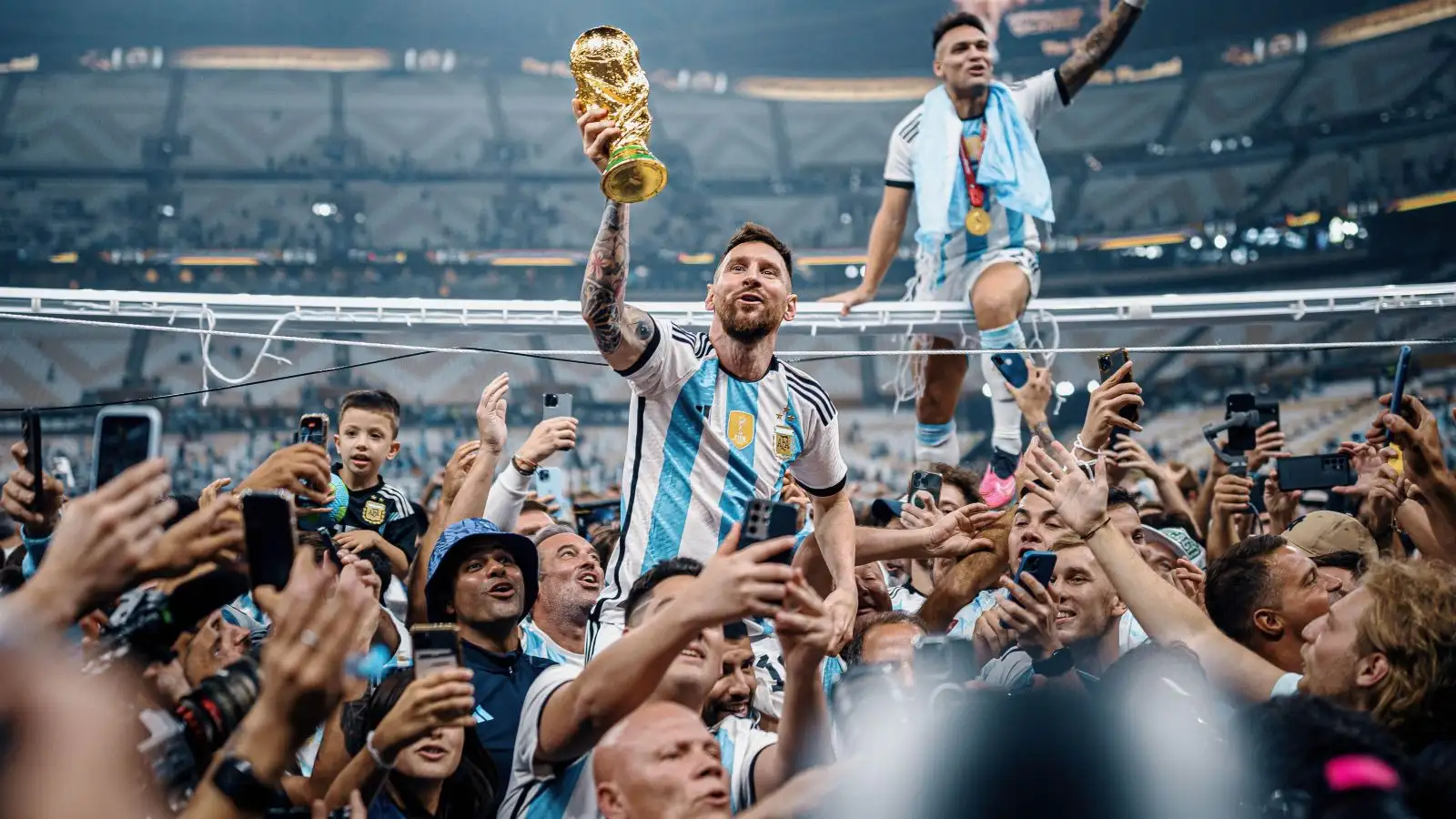
The 2026 World Cup is going to be bigger than any World Cup has ever been before. Much bigger.
While everyone might know that it is now a 48-team tournament rather than the 32-team event that has been in place since the 1998 World Cup in France – and 48 is quite a lot more than 32 – we’re still not quite sure it’s yet hit home just how much bigger this World Cup is going to be.
Every World Cup from 1998 to 2022 had 64 games. This World Cup will have 104. This time it will take 72 games – eight games more than an entire 32-team World Cup – just to get down to 32 teams.
Even though there are three co-hosts for this tournament, the USA will still host 14 more games than any other host nation has ever hosted in one tournament before, and 26 more than when it hosted on its own in 1994.
From the opening day until the end of the last 16 there will be 96 games across 27 days with no rest days. There will be only one day featuring a single game (at the start of the last-32 knockouts) and two days with just two games (the first two days of the tournament). The remaining 24 of those 27 days will feature three, four or even six matches.
Pick any three days between June 24 and 27 as the group stage reaches a climax, and you will find more matches (18) than were played in the entire 1934 World Cup (17).
So it’s huge. But how does it actually work? The format itself – if not the scale – is at least familiar.
READ: World Cup power rankings topped by Argentina
How the 2026 World Cup group stage works
It makes sense here to start with how it doesn’t work. Because FIFA’s original plan when expanding to 48 teams was to split them into 16 three-team groups.
This had some important advantages over what will actually happen. First, it’s more straightforwardly intuitive. The top two from each group qualify, with 16 group winners playing 16 runners-up in the last 32, and from there we’ve got a straightforward knockout bracket. Done.
Second, it’s not 104 games. It’s 80 games. More than the 64 of a 32-team World Cup, but still a significantly smaller leap in scale. There would also be no dead rubbers, and the winning team would still have to play seven matches – the same as every World Cup since the tournament expanded to 24 teams in 1986 – to take the title.
The downsides? One minor one is that every team would only be guaranteed two rather than three games.
But the big one, the reason that plan got abandoned? It would be bent as all hell. And if not actually bent, then at least wildly unfair.
Think about it. With three-team groups, each group only actually features three games (Team 1 v Team 2, Team 1 v Team 3, Team 2 v Team 3) and it’s impossible to have any of those games be played simultaneously. In every one of those groups there would be a team that played in the first two games and not the final one. Meaning in every group there would be two teams who would play their final game knowing exactly what they needed to do to qualify. And almost certainly in some cases knowing what result would carry both teams through to the knockout stages.
With 16 groups all potentially open to some form of manipulation, it was almost impossible to imagine how that tournament could possibly have passed without major controversy. We’re still a bit gutted it isn’t happening, because we live for the drama.
What’s important, though, is to remember that was the original plan. So when people tell you that a 104-game summer tournament crammed in between two full-on exhausting regular seasons is good, actually, you can remember it was not the actual plan when the suits, dollar signs spinning round their eyes like actual cartoon characters, decided to just chuck another 16 teams into an already very large tournament.
What we get instead is 12 groups of four. What this lacks in neatness and (relative) brevity, it does make up in terms of fairness.
If you’re old enough as we sadly are to remember the World Cups of 1986, 1990 and 1994 – or more recently the Euros in 2016, 2021 and 2024 – what you’ve basically got is an XL version of that 24-team format.
Think of it that way, and you will at least have a grasp of the basic premise. Just double all the numbers, and you’ve got it.
So the 12 group winners and 12 group runners-up all qualify for the last 32, along with the best eight third-place finishers.
How the 2026 World Cup draw works
The draw for the group stage takes place on December 5 and will be fully seeded, with the three co-hosts and nine highest-ranked nations in pot one, followed by the next 12 in pot two, the next 12 in pot three, and in pot four the six lowest-ranked teams plus placeholders for the six qualifiers who are still to be confirmed: the two winners of the six-team inter-confederation play-offs, and the four winners of the 16-team European play-offs.
With the remaining 42 qualifiers now confirmed, we have the following confirmed pot allocations, with one team from each pot being drawn into each of the 12 groups:
Pot 1: United States, Mexico, Canada, Spain, Argentina, France, England, Brazil, Portugal, Netherlands, Belgium, Germany
Pot 2: Croatia, Morocco, Colombia, Uruguay, Switzerland, Japan, Senegal, Iran, South Korea, Ecuador, Austria, Australia
Pot 3: Norway, Panama, Egypt, Algeria, Scotland, Paraguay, Tunisia, Ivory Coast, Uzbekistan, Qatar, Saudi Arabia, South Africa
Pot 4: Jordan, Cape Verde, Ghana, Curacao, Haiti, New Zealand, UEFA Play-off Path A, UEFA Play-off Path B, UEFA Play-off Path C, UEFA Play-off Path D, Inter-confederation Play-off Path 1, Inter-confederation Play-off Path 2.
Full details of the UEFA and Inter-confederation play-offs can be found here.
No more than one country from any confederation can be in the same group, with the exception of UEFA where no more than two can be in the same group.
While the increased overall numbers should in theory make the group stage more straightforward for the bigger teams, the UEFA play-off winners do lurk as dangerous pot-four floaters given some of the teams likely to come through those pathways.
At this point a potential group of death might look something like Argentina, Morocco, Norway, Italy.
At the other end of the scale sits something like Canada, Australia, Scotland, New Zealand.
USA, Mexico and Canada have already been pre-assigned their specific spots in the draw, as teams D1, A1 and B1 respectively, meaning we already know when and where their group games will take place.
Mexico open the tournament on June 11 at the Azteca, with Canada and the USA in action the following day in Toronto and LA respectively.
The dates for the group-stage matchdays are as follows:
Matchday 1: June 11-17 2026
Matchday 2: June 18-23 2026
Matchday 3: June 24-27 2026
In each group, as at previous tournaments, the final two matches will be played simultaneously to minimise the risk of any team gaining the advantage over others of knowing what they need to do. With three groups being ticked off each day, that means the group stage ends with 24 matches over four days in the most fixture-intensive period of any World Cup ever played.
How the 2026 World Cup knockout stage works
This is at least straightforward. There’s a new last-32 round – and getting 16 extra knockout games is undoubtedly one big plus of this format – but it’s essentially just a familiar knockout bracket. Just a bit bigger.
Eight of the 12 group winners will play the eight third-placed qualifiers in the last 32, while four group winners will face runners-up. The remaining eight runners-up play each other.
And from that point on, it all looks broadly familiar as the bracket carries on through the round of 16, quarter-finals, semi-finals and final.
This means the 2026 World Cup winners will play eight games in the tournament, one more than the winners of every World Cup since 1986.
Another thing to note here is that the extra groups mean, unlike the 24- or 32-team formats, group winners can now meet as early as the last 16. It’s perfectly possible for, say, France and Spain to both win their groups yet nevertheless find themselves on a last-16 collision course.
One step the organisers have taken to mitigate this is to place the three co-hosts on three of the four pathways where group winners are seeded to clash in the last 16. All of the co-hosts are seeded but all would be in pot two if it were done on ranking alone.
This does minimise as far as possible the chances of two giants clashing early without one of them having brought it upon themselves by failing to win their group, but cannot eliminate it altogether. All eyes here on which two top seeds land in Groups E and I, because they will be slated to meet in the round of 16 and it really could be any two of the remaining nine.
What are the dates for the 2026 World Cup?
The action begins on June 11 in Mexico City and concludes on July 19 in New York, so one thing to immediately note is that the vast increase in games is not matched by a similar overall increase in length. Despite an extra 40 games, the tournament is only 10 days longer than Qatar 2022.
There are no rest days until after the last 16.
The round-by-round schedule looks like this:
Group stage: June 11-27
Last 32: June 28-July 3
Last 16: July 4-7
Quarter-finals: July 9-11
Semi-finals: July 14-15
Third-place play-off: July 18
Final: July 19
Yes, we’ve still got a third-place play-off. No, we still don’t know why there has to be a third-place play-off.
Where is the 2026 World Cup being played?
There are 16 host cities across the USA, Mexico and Canada; 10 in the USA and three each in Mexico and Canada.
In all, the USA will host 78 games with Mexico and Canada hosting 13 each – including all three of their country’s group games. All games from the quarter-finals onwards are in the USA, with Estadio Akron in Guadalajara the only one of the 16 venues that won’t host any knockout games.
To at least try and minimise travel across the vast area covered by the three host nations, the 16 host cities have been split into three regions.
Western: Vancouver (CA), Seattle (US), San Francisco (US), Los Angeles (US)
Central: Guadalajara (MX), Mexico City (MX), Monterrey (MX), Houston (US), Dallas (US), Kansas City (US)
Eastern: Atlanta (US), Miami (US), Toronto (CA), Boston (US), Philadelphia (US), New York/New Jersey (US)
The idea is that each region has groups assigned to it so teams aren’t criss-crossing an entire continent every few days. It hasn’t quite worked out like that, but it is the general plan.
Where can I watch the 2026 World Cup on TV?
The 2026 – and 2030 – World Cups will once again be split between the BBC and ITV in the UK, with every match available live and free-to-air. The two broadcasters will share the games evenly, and both will broadcast the final live.