From Inter-slayers Bodø to Svalbard: A guide to football in the Arctic

This article was written by The Sweeper Podcast, a weekly world football podcast covering all 211 FIFA countries – and beyond. You can listen to The Sweeper on Spotify here and on Apple Podcasts here. You can watch on YouTube here.
Bodø/Glimt’s giant-killing debut UEFA Champions League campaign continued in sensational fashion on Tuesday night as they followed their home victory over Italian giants Inter with an away win at San Siro. They are now through to the last 16 of the competition, where a tie against England’s Manchester City or Sporting of Portugal now awaits.
The Norwegians looked dead and buried heading into their final three games of the league phase, only to draw away in Dortmund before beating Manchester City and Atlético Madrid to book their place in the play-off round. Then came the tie against Inter, which started with a memorable victory in the Arctic Circle a week ago.
Jens Petter Hauge and Kasper Høgh were the stars as the Norwegians played on the front foot and took the game to the Serie A leaders, roared on by their passionate yellow-clad supporters waving giant toothbrushes above their heads – a tradition that began half a century ago when a fan wanted to conduct a chant but did not have a baton and so used a yellow toothbrush a fellow supporter had plucked from his pocket.
Fighter pilot training to battle the Arctic cold
It might seem like an unorthodox tradition, but Bodø/Glimt are no ordinary club. Based in a town of 50,000 people in the Arctic Circle, they employ former Norwegian Air Force fighter pilot Bjorn Mannsverk as a mental coach to get them in the best frame of mind to perform and to help them deal with the freezing cold conditions.
The weather made plenty of headlines at the home game against Inter, which was preceded by heavy snowfall. The ground staff stepped in, clearing some 80 tons of snow – the weight of a full-to-capacity Boeing 737 – to ensure the match could go ahead and heaping it in piles that measured up to five metres high by the side of the pitch. But it was not simply a case of removing it from the premises and disposing of it.
The snow was brimming with rubber granules from the artificial turf – weighing approximately 300 kilograms, according to stadium manager Per-Magne Helskog Emilsen – and presented an environmental risk due to microplastics. It was instead carried directly outside the stadium, where it will melt and the rubber granules can be disposed of safely.
Production crew stranded on the motorway
The heavy snowfall caused problems beyond the pitch too – including in the stadium car park. Swede Lars Törnquist, who works as a technician for one of the production companies that broadcasts the UEFA Champions League, was forced to pick up a shovel and clear space in the parking lot for his production car.
But he was by no means the only traveller impacted by the extreme weather conditions. According to Norwegian former footballer and TV pundit Jan Åge Fjørtoft on X, a bus containing an Italian TV crew had got stuck in the snow around an hour out from Bodø on the day of the match and was blocking a lane on the E6 motorway.
It is for this reason that the Eliteserien, the top flight of Norwegian football, is a summer league that runs between March and November. That arguably makes Bodø/Glimt’s Champions League accomplishments even more impressive, as they have not played a competitive domestic match since the 2025 season drew to an end last November. The only games they have played since then have come in this memorable continental campaign.
The northernmost football pitch in the world
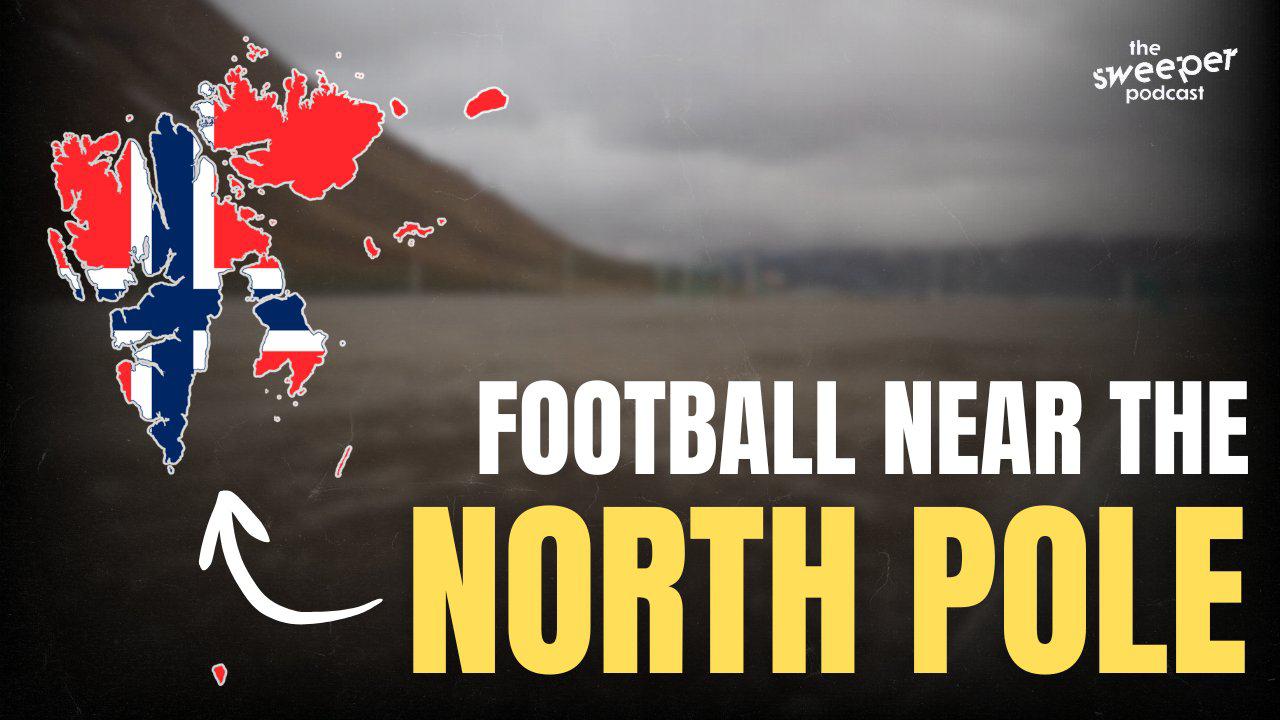
Bodø/Glimt’s Aspmyra Stadion is, however, not the northernmost football stadium in the world – or even in Norway for that matter. That title does not belong to fellow Eliteserien side Tromsø or lower-league club Alta either. In fact, the most northerly 11-a-side football pitch in the world is in Longyearbyen in Svalbard – the world’s northernmost permanent settlement, which is located midway between the northern coast of Norway and the North Pole.
The gravel pitch on this icy archipelago is not in regular use but used to host an annual game between the two still-populated settlements on Svalbard, a Norwegian sovereign territory that can be used for commercial purposes by other countries.
The match was contested by Longyearbyen, which is primarily home to Norwegian citizens, and Barentsburg, which is almost entirely a Russian coal-mining town. But the outdoor contests have now stopped, as have indoor five-a-side clashes – largely due to tensions over Russia’s invasion of Ukraine.
Seed vaults, polar bears and death bans
Local Liverpool fans, however, need not despair at the suspension of Svalbard’s limited football activity. The archipelago is home to the Liverbirds Fan Club, the most northerly Liverpool fan club anywhere in the world. On matchdays they gather together to watch, enjoying a freezing cold beer in the daytime darkness and keeping their rifles within reach on a nearby table in the event that one of the archipelago’s 300 resident polar bears makes an unwelcome appearance.
Those encounters are now becoming increasingly frequent, as the polar bears are being forced to move into areas inhabited by humans to find food due to the ever-increasing effects of climate change. Svalbard is, in fact, the fastest-warming territory on the planet. But it is still so cold that it is not advisable for people to die there, so people say: the icy temperatures mean there is a thick layer of permafrost and so bodies are not able to naturally decompose on the archipelago.
The dangers posed by polar bears and permafrost might be much smaller down in Bodø, but it remains a formidable place to visit – even for Europe’s very best teams. The further Bodø/Glimt progress in the competition and the milder the conditions become, the more that advantage may fade.
According to the X account Football Confidential in May 2025, Bodø/Glimt have a remarkable win rate of 86% when the temperature is five degrees or lower – but that drops sharply to 55% once it rises above six. That said, if the memorable wins at Wanda Metropolitano and San Siro this season have shown us anything, it is that Bodø/Glimt are no longer as reliant on the weather as people might have once thought.
This article was written by The Sweeper Podcast, a weekly world football podcast covering all 211 FIFA countries – and beyond. You can listen to The Sweeper on Spotify here and on Apple Podcasts here. You can watch on YouTube here.