England J-Team is Jones, Jones, Jones, Jones plus seven more…


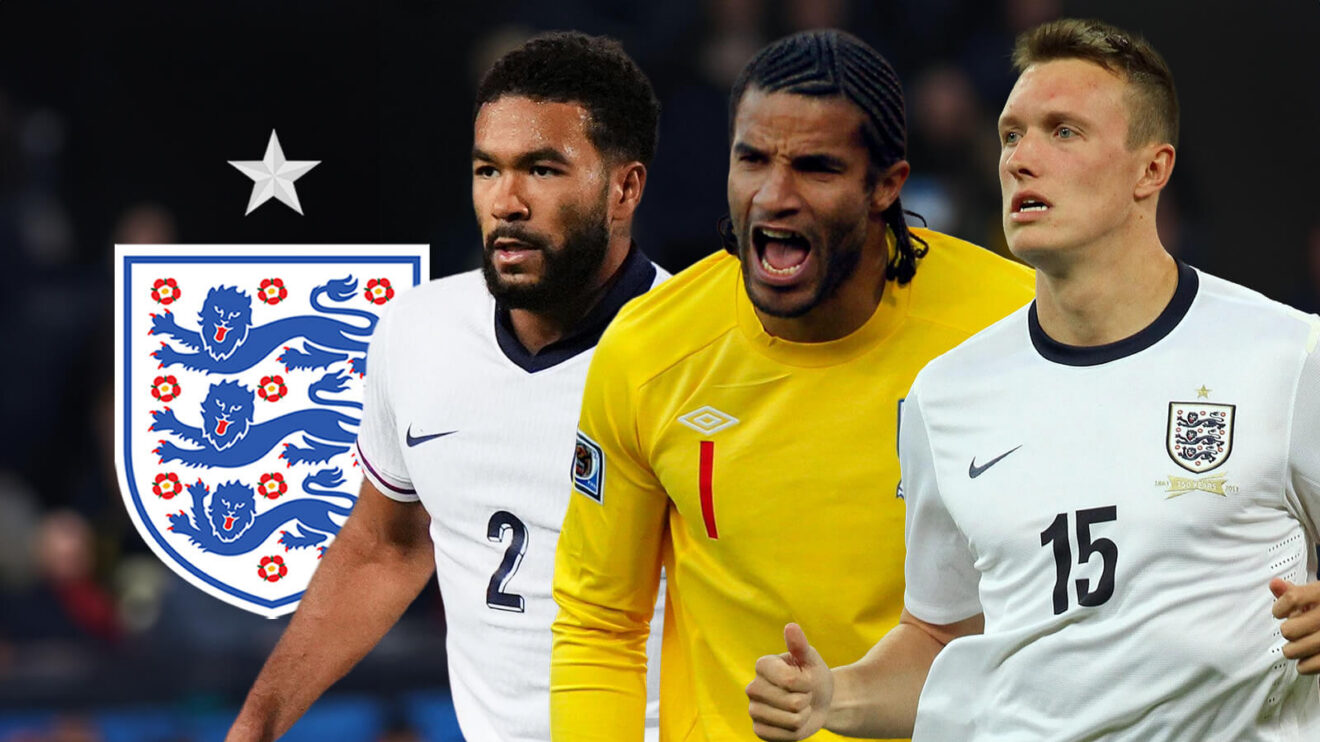
There’s no I in team, or rather there just aren’t enough I internationals to make a team, so apologies to Paul Ince and Danny Ings, but we skip a letter and pick an England J-Team.
Can the other alphabet sides keep up with the Joneses?
Goalkeeper: David James
There are only two ‘keepers available to the J-Team: David James and Sam Johnstone. James is the clear favourite to start between the sticks, with four major tournaments under his belt for the Three Lions as well as the distinction of once being in the top five most-capped English goalkeepers of all-time, before the long international careers of Joe Hart and Jordan Pickford pushed him down to seventh on the list.
If you fancy a goalkeeper challenge, try naming the former Bournemouth and Blackburn No. 1 who made a solitary appearance for the Under-23 team in 1968 but never won a cap for the senior side.
Right-back: Glen Johnson
James will have a familiar face helping to defend his goal, with former Portsmouth team-mate Glen Johnson starting at right-back. The two famously helped the Fratton Park club to FA Cup glory in ’08 and travelled together as part of Fabio Capello’s 2010 World Cup squad. James’ international career ended there with defeat to Germany and Johnson’s Three Lions spell also finished in disappointment with his last cap coming four years later in a 2-1 defeat to Uruguay as England crashed out of Brazil ’14 at the group stage.
Left-back: Rob Jones
Johnson’s presence on the right means fellow Liverpool alumni Rob Jones will have to shift to the left for a starting spot. Primarily known as a No. 2, Jones did spend some time on the opposite flank at Anfield and Gresty Road, with the former Crewe man making his England debut just four months after leaving the fourth-tier club. Jones was tipped to become a mainstay in the Three Lions side but back and knee injuries resulted in him winning his final cap at the age of just 23, robbing him of an international jostle with Gary Neville.
Centre-back: Phil Jones
Rob’s grandfather Bill helped Liverpool to the title in 1947 and is also a contender for the side, having won two caps under Walter Winterbottom. But a different Jones gets a starting spot in this XI: former Manchester United defender and meme master Phil Jones.
Rob, Bill and Phil aren’t the only Joneses available for the J-Team backline. 1920’s Blackburn Rovers left-back Herbert made six international appearances, Billy of Bristol City won a solitary cap in 1901, Victorian-era Alf was one of the first hundred men to play for England and last but not least there’s Harry, whose Three Lions debut and farewell came in a 4-1 thrashing of France.
Centre-back: Phil Jagielka
Phil Jagielka joins Jones to give this defence a very Roy Hodgson-era feel, with three of the four members playing in the disastrous 2014 World Cup campaign. Despite appearing to be one of the weaker centre-back partnerships among the alphabet sides, the two Phils did pick up 67 caps between them and although there are a plethora of Joneses in reserve, only eight players eligible for the J-Team reached double figures for England and half of them have already been mentioned.
Defensive midfield: Harry Johnston
The winning captain of perhaps the most famous FA Cup final of all-time, Harry Johnston led Blackpool to a 4-3 win over Bolton in 1953 and picked up his last cap at Wembley later that year. Unfortunately, his Three Lions farewell wasn’t one to be celebrated, after a shock 6-3 defeat to Hungary that ended England’s long-standing unbeaten home record against foreign opposition. Eight changes were made for the following match against Scotland a few months later and at 34, Johnston wasn’t part of the new-look squad looking to bounce back at the World Cup in Switzerland; a tournament that fabulous Hungary side controversially lost in the final.
Central midfield: Reece James
The J-Team is certainly lacking in some areas but right-back isn’t one of them. Glen Johnson, Rob Jones and Reece James can’t all wear the No. 2 shirt so James will have to start in midfield. England boss Thomas Tuchel is of course familiar with the Chelsea captain following their Champions League-winning campaign together back in 2021 and he’ll hoping the Stamford Bridge star can follow up on his Club World Cup victory in the United States last year with more glory across the pond this summer.
READ: Eze aims to resist walkout again as unlikely England hero emerges – World Cup squad number analysis
Central midfield: Jermaine Jenas
Jermaine Jenas was accustomed to lining up alongside a Jones off the field for The One Show and given how that ended, his presence alongside all of Alex’s namesakes could prove to be a bad omen for the J-Team.
Much was expected of Jenas when he saw off competition from Wayne Rooney to pick up the PFA Young Player of the Year in 2003 and won his first England cap in the same year. However, despite making the 2006 World Cup squad, he never played a minute at a major tournament for the Three Lions and his international career was over at the age of 26.
Central midfield: Curtis Jones
He makes the J-Team but Curtis Jones didn’t make the cut this summer, leaving England without a single Liverpool player in a World Cup squad for only the third time since their maiden tournament in 1950. If the XI seems a little Jones-heavy there are a couple of Premier League era one-cap wonders waiting in reserve, with Seth Johnson making a solitary appearance under caretaker boss Peter Taylor at the turn of the century and former Wolves winger Matt Jarvis winning a cap against Ghana in 2011.
Striker: David Jack
One of only four men to have broken the world transfer record twice, David Jack joins Alf Common, Diego Maradona and the Brazilian Ronaldo in that elite band and he was the first player to command a five-figure fee following his move to Arsenal from Bolton Wanderers. He scored in the famous ‘White Horse Final’ of 1923 for the Trotters, securing the club’s maiden FA Cup triumph, before helping the Gunners to their first three league title wins under legendary Highbury honcho Herbert Chapman.
England’s refusal to participate in the inaugural World Cup of 1930 denied Jack the chance to prove himself as one of the finest forwards on the planet.
Striker: Mick Jones
Joining Jack in attack is Leeds United hero Mick Jones, who was part of the Elland Road golden era under Don Revie in the late sixties and early seventies. Despite being part of two First Division title-winning teams, Jones never became a England regular with the fierce competition up front for the Three Lions at the time limiting him to a handful of caps. Former Fulham forward Bedford Jezzard takes a spot on the bench, alongside the Johnsons of Andrew and David.