More VAR, fewer tactical timeouts and advert breaks among law changes for the World Cup


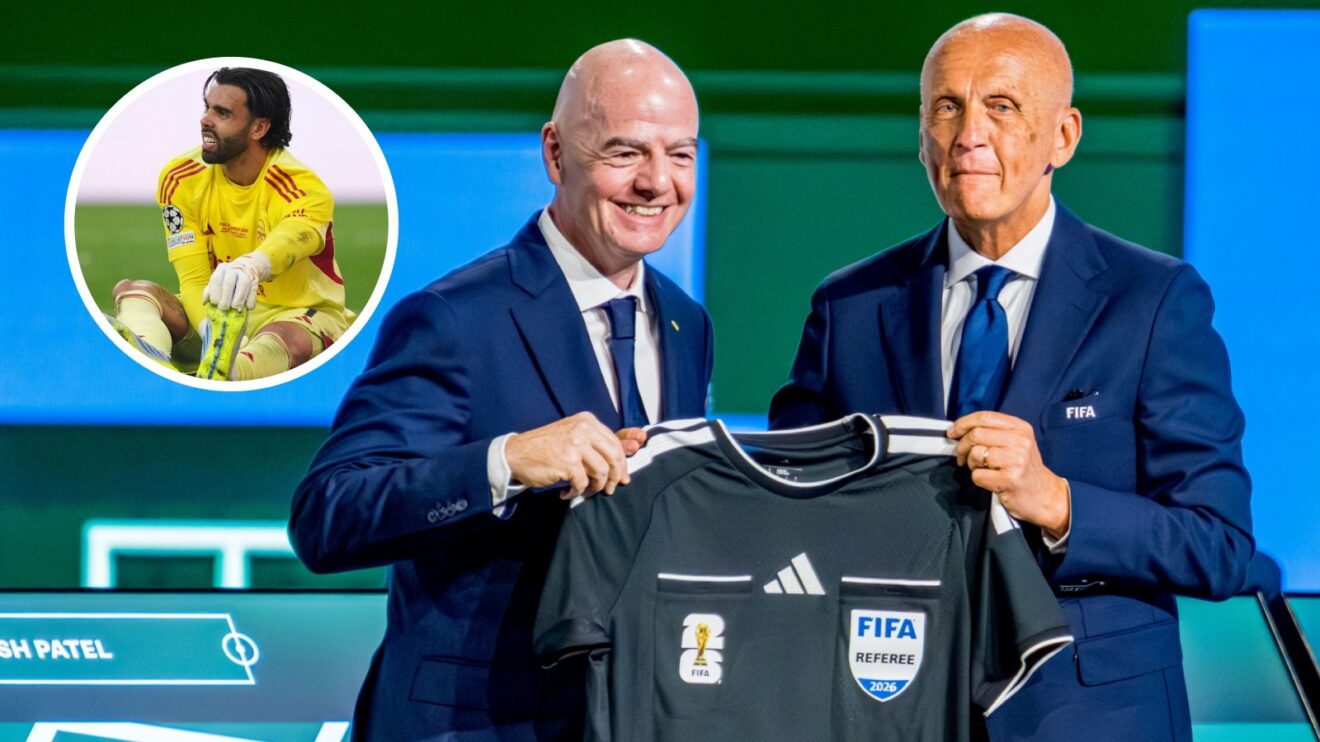


Among a raft of laws being changed for the World Cup, IFAB are trying to stop tactical timeouts when goalkeepers go down but we still expect the loophole to be exploited…
The International Football Association Board (IFAB) has made changes to the laws of the game which will not only apply to the World Cup, but also from the 2026/27 season onwards.
“The IFAB approved a set of landmark changes to the Laws of the Game and the FIFA World Cup 2026 will be the first major tournament to use them,” FIFA’s chief refereeing officer Pierluigi Collina said.
“These amendments aim to tackle discrimination, cut time-wasting, enhance match tempo and improve both the player and fan experience.”
Here are the changes…
Red cards for players covering their mouths
A player who covers their mouth with their hand, arm or shirt in confrontational situations will receive a red card.
The new rule comes into effect after Benfica’s Gianluca Prestianni was accused of making discriminatory slurs to Vinicius Jr with his mouth covered. Prestianni was given a six-game suspension by UEFA, with his ban extended worldwide.
However, players who cover their mouths while having friendly conversations with club team mates on opposing teams, for example, will not be punished.
“We respect that there are players who are friends and it is normal to chat before, during or after the match,” said Collina. “When it is confrontational, it is a completely different story.
“Covering the mouth means you are doing something potentially very wrong. This is something you do on purpose. It is not something that a player can do instinctively.”
This article is brought to you in partnership with ExpressVPN. With millions of fans set to follow the World Cup from around the globe, ExpressVPN helps you stream matches securely and access your favourite football content wherever you are. Find out more here.
The ‘Senegal rule’
Players who leave the pitch to protest about a referee’s decision will be shown a red card. The rule will also apply to any team official who incites players to leave the field of play in protest.
In addition to that, teams which cause a match to be abandoned will now forfeit the match.
This rule comes into effect after Senegal stormed off the pitch in protest at a penalty awarded against them in the 2026 Africa Cup of Nations final, causing a 16-minute stoppage before they returned to beat hosts Morocco 1-0 after extra time.
However, in March, CAF overturned the result, judging Senegal’s mass protest to be a forfeit of the game. Senegal are appealing the verdict, but the laws are now clear to deal with any team tempted to walk off in protest over an official’s decision.
MORE: Brahim Diaz’s Panenka penalty only the second weirdest thing about AFCON final…
Countdowns for throw-ins and goal-kicks
Buoyed by the success of the eight-second rule for goalkeepers, IFAB are rolling out five-second countdowns for throw-ins and goal-kicks.
As they already do when keepers have possession in their hands, referees will start a visual five-second countdown with a raised hand.
On throw-ins, if the ball is not in play at the end of the countdown, the throw-in is awarded to the opponents.
If a goal-kick is not taken at the end of the countdown when the referee judges that the taker is deliberately delaying the restart, a corner kick is awarded to the opponents.
“We are not expecting to have many throw-ins or corner kicks given, we expect the players to respect the limits given,” explained Collina.
Speeding up substitutions
Referees will also give a five-second countdown to players leaving the pitch when being substituted.
Overall, they will now have a maximum of 10 seconds to get off when the substitution board has been shown. And they must exit at the nearest point on the boundary line.
If the player being substituted does not leave the field of play within 10 seconds, the substitute may enter only at the first stoppage after one minute has elapsed following the restart and the referee gives them the signal.
There will be some exceptions around player injuries and concerns related to safety and security.
One minute off if the physio is on
Until now, there was no stipulation in the laws of the game over how long a player must stay off the field after receiving treatment on it. Leagues have had the right to set their own guidelines, with the Premier League adopting a 30-second delay since 2023-24.
Now, though, an outfield player must leave the field of play for one minute after the restart if medical staff entered the pitch to treat them.
There are exceptions: goalkeeper injuries; collisions between a goalkeeper and outfield player; when a player is injured as a result of a yellow or red-card offence; collisions between team-mates that require attention; severe injury, such as head injuries and concussions; or when the injured player is set to take a penalty.
Goalkeeper injuries and tactical time-outs
This one is a work in progress… in an effort to stop tactical time-outs prompted by a goalkeeper receiving treatment on the pitch, players from both teams will not be allowed to ‘go to the bench’.
Collina revealed that the issue was discussed at an IFAB meeting in March with all World Cup competing nations but there is work still to be done before laws can officially be changed.
“I’m afraid we didn’t get a solution agreed by everybody,” said Collina. “We told them that referees will be proactive and will not allow the two teams to go to the bench when a goalkeeper is lying down injured.
“He has a right to be injured, but the players do not have the right to have a timeout. Certainly, something will be done in the future.”
Until there is something written in to the laws, we expect this still to be abused, even if only to halt the momentum of matches rather than for the purposes of a full-blown time-out.
MORE: God help us because Arsenal grindcore will be copied across football
VAR’s increased scope
Since everyone loves VAR so much, IFAB have promised us more of it…
VAR may now intervene for the following incidents:
- A red card issued from a clearly incorrect yellow card.
- Mistaken identity: a player is shown a yellow or red card for an offence committed by another player.
- Incorrectly awarded corner kicks: VAR can intervene if the decision can be corrected immediately without delaying the restart.
- VAR can now intervene when a foul is committed before play restarts. For example: when an attacker fouls a defender before the ball is in play from a set-piece.
On the final point, this is to close a loophole in the previous laws which dictated that fouls which precede the ball being live – before a corner or free-kick was taken – could not be punished.
Collina cited England and Adam Wharton’s block against Uruguay that led to Ben White’s goal in their March friendly as an example of what IFAB are seeking to eradicate.
“We started with VAR in FIFA competitions in 2017, at the Confederations Cup before the World Cup in Russia in 2018,” Collina said. “So, we think it is the time to reconsider the protocol which was written when there was very limited experience.”
“I don’t think any of you would be happy for a goal coming as a result of a foul being committed and the reason being that VAR cannot intervene because of protocol.
“Let’s sort this and see what can be next. Changing a wrong corner decision and a foul committed by an attacker is a good step forward.”
Advertisement Hydration breaks
At the World Cup, there will be a three-minute hydration break around the half-way point of each half in every match.
Referees have some flexibility with the timing of the break, allowing them to signal for the hydration break if a player is receiving treatment around the 20 minute mark.
FIFA have already given commercial broadcasters the go-ahead to screen advertisements during the breaks, as long as they don’t start within 20 seconds of the break being signalled, and they must end 30 seconds prior to the restart.
This article is brought to you in partnership with ExpressVPN. With millions of fans set to follow the World Cup from around the globe, ExpressVPN helps you stream matches securely and access your favourite football content wherever you are. Find out more here.
All of which equates to around an extra seven and a half hours of in-game adverts over the 104 matches.