‘I’ve been told to f*** off’ – the reality of football meeting foodbanks


What does it mean to be a football supporter in the 21st century? A new book from Alex Timperley of MCFC Fans Foodbank Support – ‘For the Love: How Football Supporters Can Change the World’ – tries to answer that question.
It examines what our clubs really are, what supporters are up against and how we can organise effectively against billionaire owners and powerful broadcasters. Most importantly, it shows how the same tactics, cooperation and solidarity can be harnessed to reestablish the link between football and its communities to transform life for working-class people up and down the country.
This extract focuses on how it’s done at Southend, a community which has grown closer and stronger thanks to links made at the football…
Southend breaking down community barriers through football
In Southend, we see football supporters and the local foodbank in complete sync from the start.
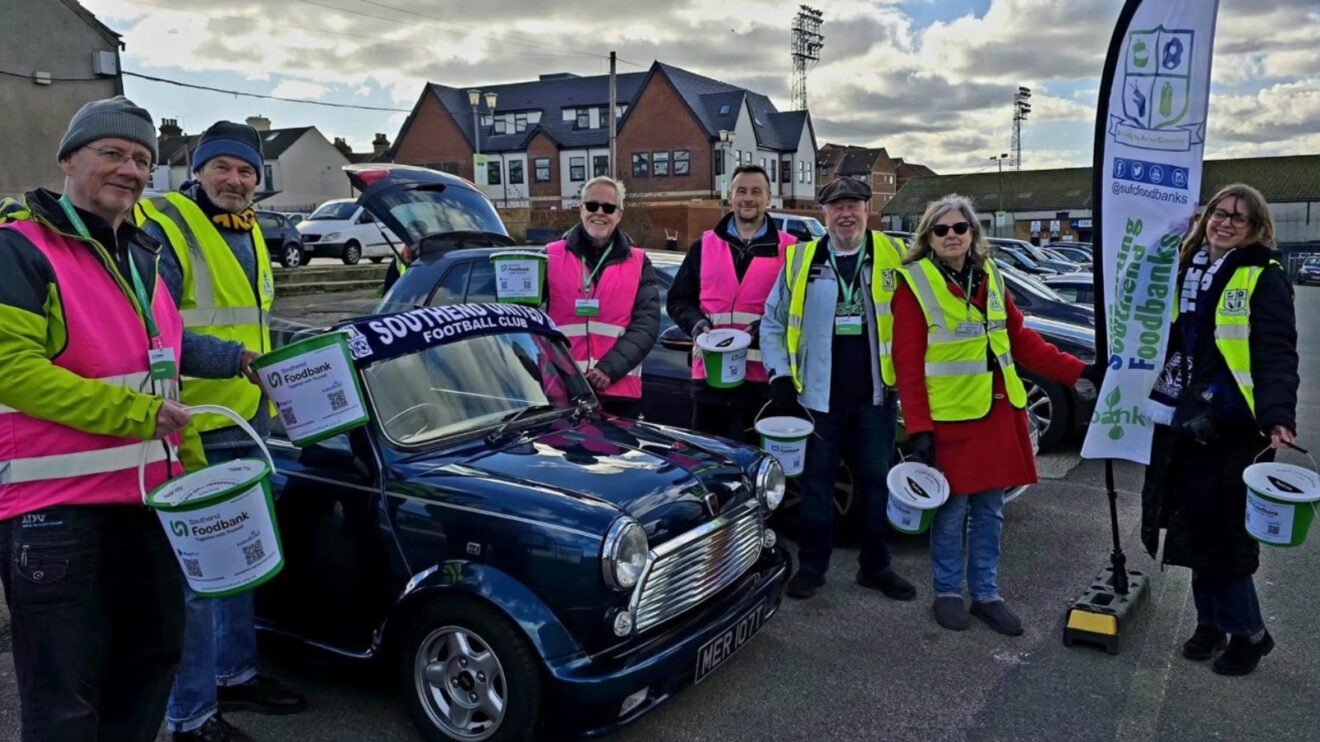
Sarah Godfrey is both a Southend United season ticket holder and a long-time volunteer at the local Trussell Trust foodbank. She is also a member of the local Fans Supporting Foodbanks collective.
Southend punch above their weight for a non-league outfit, regularly drawing crowds of 8,000 or more. The club has been through serious trauma in the recent past thanks to the ‘stewardship’ of its former owner, Ron Martin. Southend came within 42 days of being wound up by the courts and it took waves of protest and co-operation between supporters, MPs, the local council and businesses to save the club. It is now owned by Justin Rees’ consortium, the Custodians of Southend United, and all is well for the first time in years. That background perhaps explains why Southend has such a strong community around the club.
Sarah says: “I know every football team will tell you that they have a really passionate fanbase, but ours really are, because the club almost went to the wall. A large part of the decisions made in the courts were based on how important the club was to the community. That was really the only thing that bought the previous owner more time to find new buyers.”
There’s nothing like a near-death experience to bring people together. A big consequence of that togetherness among Southend supporters is the backing of the local branch of Fans Supporting Foodbanks. Sarah continues: “We started not long after Southend were relegated out of league football and it was the first time the club were really interested in being approached. We came through in a slightly different way as about half our members work or volunteer at the foodbank. We have a much closer connection between the foodbank and supporters, to the point where sometimes the two don’t look that different.”
Publication day is here! What a feeling, thank you to everyone who has bought ‘For the Love: How Football Supporters Can Change the World’ via @HalcyonPublish1 !
I appreciate every one of you, thank you! pic.twitter.com/aI8fsnc5vY
— MCFC Fans Foodbank Support (@MCFCfoodbank) July 6, 2026
This is a point of difference with other Fans Supporting Foodbanks groups, and it has caused Sarah and the FSF team some issues.
On one hand, they end up doing things that foodbank staff and volunteers don’t normally do, like going to the pub and having a beer with football supporters as part of a normal matchday, or accepting tickets or other freebies from the club to raffle off to raise funds. Charities don’t normally do that sort of thing, for good reason. On the other hand, they’re wary of preaching to football supporters, or seeming like they are using the game for their own ends. Behaving, in Sarah’s words, like a Parent-Teacher Association rather than Southend supporters.
The protests and surrounding issues are a case in point. The group runs two collections a season on specified match days, along with a permanent static collection point next to the Southend ticket office and many quizzes, raffles and other fundraising events in local pubs. In 2023, one of the collections fell at an awkward time.
“We had a collection planned on the date of a big protest [against the previous owners] and my heart sank. Like, we should be on that protest. As individuals, half of us would have been there anyway. I’d been to the last three. We don’t want to be that charity group that is somehow removed from the reality of it. So we had some conversations about what the line is and how sometimes it’s more important to preserve the integrity, not the neutrality. We’re not going to be neutral as a group, but we want to have integrity.
“So when the match day collection came round, one of the older members of our group said we should do what we always do. Go to the pub, have a chat with people. One of the people who was helping organise the protest also helps run the local fanzine. He talked to a few more people and the word came back to go ahead with the collection, and to know that we had the support of the Southend fans. It sounds almost a bit mafia because it’s all really tight knit.”
This close link between foodbank collections, supporter groups and local community concerns has shown up in other ways, too. There was half a season of boycotts at Southend, and questions were raised about the possibility of a strike. Players and club staff weren’t being paid during the worst days of the previous ownership and it raised real questions about the viability of foodbank collections. Was it fair to collect food donations when the people helping them out within Southend FC weren’t getting their salary? What if those same people needed foodbank help themselves, how would that work?
“We reached out through the Community Trust and said we understand that walking into a foodbank is a really, really difficult thing for the first time. If there’s anybody on the staff at the football club who needs to have a foodbank voucher because they haven’t been paid, we will issue them and do it separately,” says Sarah.
“We offered to do home deliveries because people are recognised in the local community. There was a real concern around people not being able to get help because they didn’t want it to be front-page news the next day. There was so much local media speculation and members of staff were actively being stopped by complete strangers wanting to know what was going on. That’s intrusive, it’s not OK to stop people and make them disclose how screwed they are. So there were all sorts of little minefields, but every time the solution came down to having a chat with people and offering help.”
That even meant temporarily pausing their fundraising work in the local pubs. There was a hardship fund being collected and it didn’t feel right to ask people to put their money elsewhere at that time, so Sarah and her team pulled all cash collections during the toughest periods of protest. Even during better times, though, it’s not always easy. Anyone who has done charity work knows that the reception can be frosty at times. It’s no different at the football.
“We have people who don’t want to donate. We have people who say they don’t believe in foodbanks. I’ve been told to f*** off and had people come up to me at half time wanting to have a conversation about something they’ve heard or read about foodbanks. But as long as you’re basically doing your best and trying not to annoy people it’s mostly OK. If there was enough of a groundswell that people didn’t like what we were doing, we wouldn’t be able to do it. That’s true for any group. The other side of being in a close-knit community is you have to have a certain amount of social approval.”
That comes through hard work, consistency and engaging with everyone you can. Sarah points to their pub activities as an example of this, stating how important the local landladies are to the community and the club alike: “The landladies, because they’re the pubs really close to the ground, they sit on the Shrimpers Trust. So we’ve got these multiple relationships where, because we did something over there, we can do another thing over here. We did something in the first pub that got us into the second pub, which meant the Trust gave us a whole bunch of advent calendars last year that were left over from something they did with their own youth group. So it’s that kind of thing. It is real. We are all part of the same community. It is all connected.”
In return, Sarah and the FSF group bring people into the foodbank to see how it all works, from the landladies to the club mascot and even the new owner of the Consortium, who was persuaded to go around the pubs with a collection bucket, much to the enjoyment of the regulars.
She said: “Whenever we do football stuff, we invite people to come into the foodbank and see the impact of the donations. One of the things I say to them all is, there are people who come here and find it hard to accept the help on offer. But I have sat with people over the last few years and said it’s a bag of food, yes, but it’s a bag of food because there’s people all around the city who believe it is right for you to have a hot meal tonight. That you deserve a hot meal with your family.
“It’s not a handout, it’s shocking that you are in this situation, but there is so much love and respect for you around the city that people who don’t know you, don’t know your circumstances, believe in you. A lot of foodbanks will talk about the tangibility of donating to people’s kitchen cupboards. What doesn’t get seen is the other side of that. Ultimately, someone bothered to put something in a foodbank bin because they care. Or they have a conversation because they care. For many that is a real community connection that makes them feel like they do deserve the help, even at the lowest point in their lives.”
Furthermore, Sarah emphasises what makes the Fans Supporting Foodbanks network different, saying: “Anyone can do fundraising through a football club, but that’s not what we do in FSF. The moral compass that the national group gives through ‘Hunger Doesn’t Wear Club Colours’; seeing ‘Hunger is a political choice’ written down and to be able to tie that into what we’re doing in Southend. That step back from commercialism without being nostalgic for a time that wasn’t good for everybody, being part of a group which can separate out the commercialism from the football is so special.
“The reason we’ve been able to keep going over the years, with integrity and maintaining the social approval needed to keep going, to have the group we have and keep people coming back year after year, that’s possible because of the authenticity of supporters. A small group of people who are genuinely committed for the right reasons, without the need for thanks and recognition.”
Despite that, it is a pleasure to be able to give Sarah, the FSF group at Southend and the wider Southend supporter base the recognition they deserve. This is a community club which has been through fire and come out stronger thanks to supporters sticking together and working hard to fight for their club and their community.
Sarah will tell me off for writing this, but they are a credit to the football community and society.
Buy ‘For the Love: How Football Supporters Can Change the World’ from Halcyon Publishing today.