Five ballsy Daniel Farke decisions fuelling Leeds’ likely survival



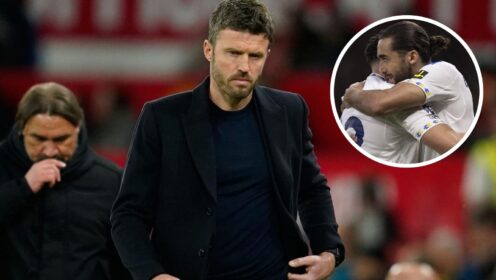
Leeds United showcased their brilliant improvement under Daniel Farke by claiming a deserved, though ultimately hard-fought, 2-1 win at Manchester United on Monday night to cast aside plenty of relegation doubts – but what are the five big decisions that the German has made this season that has led the club to the cusp of safety?
It had been 45 long, often tortuous years for Leeds since their last league triumph at Old Trafford. A lot of water has passed under the bridge since then, but even in their all-too-rare better days under Howard Wilkinson, David O’Leary and, more recently, Marcelo Bielsa, the Whites had failed to claim a three-point haul at the home of their arch rivals.
Until that is, Herr Farke stepped to the plate and decided enough is enough.
Incredibly, as revealed by great statistician Jonny Cooper, Leeds have played 1919 league games since their last triumph there back in 1981, with two goals from a player (Noah Okafor) wearing the No.19 shirt…
For those that don’t understand the reference, Leeds United were founded in 1919 – perhaps alluding to the fact that maybe Monday’s win was actually written in the stars.
For the non-superstitious among you, though, that victory on Monday was no fluke – oh no, sir! – with Leeds now suffering just four losses across their last 23 games in all competitions. An FA Cup semi-final – their first since 1987 – also awaits… hardly the sort of form that befits a team battling relegation, and more in keeping with a side upwardly mobile and feeling they belong among the elite.
But getting to this point has been far from easy, and Farke has had to make a number of key decisions to get both himself and the club to this point.
Here are his top 5 most monumental decisions this season…
5) Adding height and physicality to the side
Leeds were able to spend £100m on new players over the summer – a sizeable kitty for the club, though perhaps not one of the largest when you consider the multiple hundreds of millions spent by those already established in the top flight.
Nonetheless, Leeds – with Farke very much a key figure in their transfer planning alongside sporting director, Adam Underwood – knew what they had to do.
Recognising that the Premier League was going all out physical, with a strong emphasis on set-pieces (a weak point for Leeds in previous campaigns), Leeds sought to sign some towering footballers to add height, physicality and athleticism to their ranks. Indeed, all but one of their 10 summer signings stand at 6ft-plus.
Given the way the Premier League has gone this season, and given how effective Anton Stach, Jaka Bijol and Dominic Calvert-Lewin have all been, it’s safe to say Leeds gave themselves a fighting chance in more ways than one.
Leeds United’s recruitment was effectively land of the giants.
It’s served us well so far…Here they are by height of recruit. Some big lads!!#LUFC https://t.co/bEKEVm136m pic.twitter.com/OUFpfMzxhK
— James Marshment (@marshyleeds) September 30, 2025
4) Ditching Perri and picking Darlow
Of course, not all summer signings work out, and while there has been some redemption in the FA Cup, it’s safe to say Lucas Perri remains second choice for Leeds.
The Brazilian was soon injured, lost his place, regained it, before losing it again in the midst of a barren run of form that saw Farke’s future called into question during the autumn.
A somewhat embarrassing free-kick goal conceded to Aston Villa’s Morgan Rogers, in which he dinked a simple effort over the wall and past a flat-footed Perri, seemed the final straw.
Since then, the experienced Karl Darlow has effectively made the position his – and the former Newcastle man has not put a foot wrong. Indeed, the 35-year-old proved his worth once again on Monday night, making a string of fine saves to keep 10-man Man Utd from snatching an unlikely point.
But it’s not just the saves that ensure he’s well ahead of Perri. It’s his calmness in the area, his ability to command his box and authority in possession and passing range (something the Brazilian lacks) that means Farke got this big call absolutely right.
There’s probably a lesson learned here when the Leeds boss also ditched Illan Meslier at the back end of last season, proving that sometimes the best calls are often the most obvious ones.
3) Unleashing two of the best wing-backs around
When Leeds were promoted, the club felt they had a nucleus of six Premier League-ready players they could build around; the rest would have to be brought in, hence the 10-player spree during the summer.
One of those they knew would be dependable and capable of making the step up was Jayden Bogle, outstanding in the Championship during his first season at the club.
Across the other flank, Leeds had decided to let Junior Firpo leave as a free agent, with the left-back rejoining one of his former sides, Real Betis, but with the Whites wary of his defensive frailties the last time they were among the elite.
Signed in his place was Gabriel Gudmundsson, a £10.3m (€12m) snip from Lille. That transfer has proved a masterstroke, though it was not until Leeds reverted to a 3-5-2 formation that Leeds were truly able to see both full-backs – or wing-backs – at their truly fluid best.
Stretching the opposition, the pair have been menaces down the flanks and, while the system has limited the likes of Dan James and Wilfried Gnonto, they have given Leeds real flexibility, tremendous energy, a hard-to-beat resistance and some genuine attacking flair from the flanks.
2) Insisting on signing Calvert-Lewin
Incredibly, Calvert-Lewin was without a club until August 15 following his release by Everton at the end of the previous season. While others scoffed at the chance to take a chance on him, Leeds believed there was a player there who could aid their chances.
Yet, remarkably, he wasn’t Leeds’ first choice either, with the club pursuing and talking to a few other options first. Ultimately, it was Farke’s insistence – and convincing chat to Calvert-Lewin – that persuaded him to sign.
The move has proved a masterstroke. No, he’s not in the same fluid form as the winter that resulted in eight games across seven games. And yes, he missed two absolute gilt-edged chances on Monday night for Leeds.
But anyone who sees him play knows how much of a better side Leeds are when he is playing. And his ability to hold up the ball, occupy two defenders at once, bring others into play, win pressure-relieving free-kicks, not to mention the odd clearance off the line, have made a whole world of difference to Leeds United.
At this moment in time, you’d struggle to name too many more better free-transfer signings this season – and Leeds very much owe Farke for his insistence and determination to get this one over the line.
1) Switching to a 3-5-2 – and having the balls to change
Of course, the whole improvement would not have been possible without the mid-season shift to a 3-5-2 formation.
With Farke, by widespread accounts, clinging to his job and faced with the sack, he altered formations at half-time during the trip to Man City in late November. Fighting back from 2-0 down to tie level at 2-2, Leeds ultimately slipped to a 3-2 defeat at the Etihad after some late Phil Foden magic.
However, the seed was planted. It was Farke’s “f*** it” moment! A victory over Chelsea straight after that City defeat, followed by a battling 3-3 draw with Liverpool backed up that change, and Leeds have remained, by and large, a 3-5-2 side ever since.
That formation and game plan was executed to perfection at Old Trafford during the first half on Monday night. Breaking through the lines, providing width through full-backs and with a well-executed press, Man Utd had no answer to Leeds and were, quite frankly, fortunate the scoreline was not bigger by half-time.
For Farke, who had stuck rigidly by a 4-2-3-1/4-3-3 formation throughout his coaching career, it was not just a brave call, but an unexpected one.
But it’s certainly proved monumental – and now has Leeds dreaming of not just Premier League safety, but potentially, a first FA Cup final since 1973.
Going forward, Leeds are also now planning their summer spending around players who can operate in a 3-5-2/3-5-1-1 formation, such has been their success with it. It’s here to stay.
Indeed, they will have taken huge encouragement from executing that plan to perfection at Old Trafford; the irony not lost on the fact that Michael Carrick’s predecessor, Ruben Amorim, had tried – and ultimately failed – to play that way for the Red Devils.
READ MORE:
Roy Keane sends message to ‘brilliant’ Leeds boss Farke as he ponders sliding doors sack decision
Michael Carrick damned by Man Utd’s inexcusable failure to be ready for Leeds
Premier League predicted final table: Spurs doomed as De Zerbi bounce fails