Top 10 moments when joyless, buzzkill VAR got it wrong even when it got it right


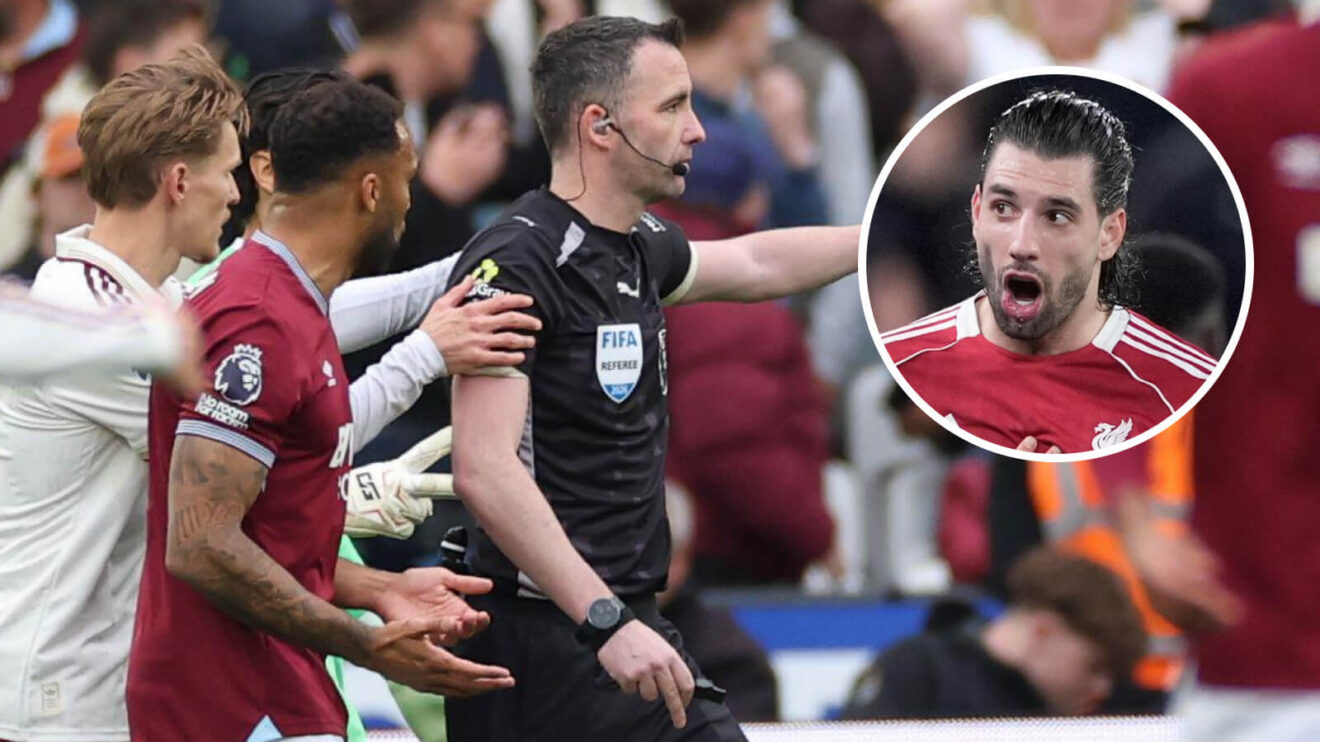
As the fall-out from what literally nobody is calling WestHamdisallowedequalisergate continues, the VAR picture is becoming clearer.
It turns out that most people never really wanted 100% correct decisions. They wanted football with the most obvious creases ironed out. A lot of the time what they really wanted was just decisions that went the way of their team, please.
The human brain is a right tw*t, and thus enormously prone to remembering all the times decisions went against your team but forgetting all the times decisions went in your favour.
We would put every penny we own – and we don’t like to brag, but that is quite literally several pennies – on the fact that a vast majority of football fans would tell you with a straight face and in utter earnest that their team is hard done by with the officials.
We would double down that every fan who wanted technology thus thought their team specifically would benefit from it.
What it turns out they didn’t really want – at least not in majority numbers – was what we inevitably got: a system that prioritises objectively correct decisions at the expense of all other considerations. Turns out a lot of the time we all prefer things that are dramatic and funny and p*ss-boiling to things that are Technically Correct.
MAILBOX: Arsenal controversy leaves us needing law change: ‘Corners don’t have to be stupid’
We can all rage at VAR when it goes wrong – that’s easy. The real killer for VAR, the real reason it should be fired directly into the sun, is just how often it’s ‘wrong’ even when it’s right.
Here are 10 times VAR made the correct decision and still managed to ruin things in many people’s eyes.
Are there actually 10 things here, really? We prefer not to speak. But this feels like it’s a top 10, and there’s no VAR here to come along and point out that actually ‘maths’ says it isn’t a top 10. And, really, isn’t that the point?
Shut up, it is.
8-10) Any three toenail/armpit/shoulder offside decisions of your choosing
They are literally countless by now. Pick any three you personally remember. We seem to recall a particularly ridiculous looking one that denied Teemu Pukki a goal against Spurs one time. But the point is, you’ve had several go in favour of your team, you’ve had several go against your team.
They are all incredibly annoying and all highlight just how pernicious the phrase ‘technically correct’ can be once you allow soulless, joyless robots and nerds to take charge of your messy, subjective, gloriously daft game.
If you say things like “I don’t mind VAR, but don’t like these tight offsides” then you are entirely part of the problem. If you are Arsene Wenger coming up with legitimately insane ‘solutions’ then you are entirely the actual problem.
But say what you like about Wenger’s ludicrous plans – and we have, at length – at least what he’s proposing would bring an element of slapstick farce to proceedings for a short while before football just regresses entirely into low-block misery to avoid getting pied off by Le Professeur’s brainfart of a policy.
What we currently have is a VAR system that deals in absolutes while pretending offside is as objective as whether the ball has crossed the line. It is the most frequent and egregious way in which the technology just spoils things. It is the clearest example of the law of unintended consequences VAR has given us.
We’ll repeat this for sure before this piece is out, but we’re absolutely not going to sit here and pretend people didn’t complain endlessly about decisions in the pre-VAR days. They did, at length, and that’s a large part of why we are where we are now.
But while obviously bad offside decisions were for sure a source of some of that complaining, we really do think that offside was one area where fans and pundits had some sympathy and acceptance that millimetre-precise perfection wasn’t a realistic aim. Even the most basic offside decision requires a lino to be looking at three things at once, all of them potentially moving at speed in different directions: the pass, the attacker, the last defender. It is, in essence, impossible to do it with one hundred per cent accuracy.
It was miraculous there weren’t more historical, pre-VAR howlers in this area, frankly.
We might well be misremembering – the mind plays tricks – but we are almost certain that before VAR the phrase ‘just about level’ was common parlance in the game when a goal featured a marginal offside call.
Sure you might not like it when it went against you, but broadly speaking, most people were mostly fine with ‘just about level’. At the very least, chalking off as many of these ‘just about level’ goals as possible wasn’t the key driver behind VAR’s introduction.
It was the hard-to-pin-down-but-I-know-it-when-I-see-it ‘howler’ people wanted rid of, wasn’t it? That’s what people wanted gone. But with technology you’re never going to get a system that only gets rid of those. Once you let technology in, it will start rigorously applying the laws as they’re written not as we’ve always kind of wishy-washily-but-kind-of-acceptably applied them in the real world.
A toenail offside? That’ll be offside then. Your ‘just about level’ butters no parsnips in the brave new world.
7) Big Ange’s big booboo
Most of these come under the category of correct decisions that are annoying or piss-boiling or just plain dreary in a scenario when most people could have lived with a wrong decision that felt right and/or was more exciting and/or dramatic.
But we include this one because it was funny and it’s worth remembering that even a buzzkill joyless system designed to make the sport less good and fun can still sometimes accidentally end up nailing it.
This one would barely register normally, VAR taking a look at an apparent Pape Sarr equaliser at Chelsea late last season and concluding there was a foul in the build-up on Moises Caicedo. So far, so mundane. Can’t even say it affected the result because Spurs would have gone on to lose anyway because they always lose at Chelsea. The only ground they’re less likely to win at than Stamford Bridge is, sadly, their own.
No, what makes this VAR intervention sing is how Ange Postecoglou responded to the goal, cupping his hand to the away supporters in the clearest sign yet that the relationship between manager and fans at this most febrile of clubs had broken down. The Europa League ridiculousness would allow both parties to pretend they were still very much in love, and there are lots and lots of Spurs fans now pretending they never said anything bad about Big Ange at all, actually, but there was genuine anger there as last season’s domestic campaign collapsed.
But the key here was Postecoglou’s insistence that he had not in fact done precisely what we all saw him do in deciding an equalising goal was the moment to goad his own team’s supporters.
“It’s incredible how things get interpreted. We just scored, I just wanted to hear them cheer.
“We’ve been through a tough time and I thought it was a cracking goal. I wanted them to get really excited.”
Not since Principal Skinner was only in a burlesque house to get directions on how to get away from there has an excuse rung more hollow.
6) Bernardo Silva’s flawless timing
We’ll get to another similar but crucially different example from a few months earlier that went the other way soon enough, and the fact both decisions went against Gary O’Neil’s Wolves does explain why his head was fully detached and somewhere orbiting Mars. In an offside position. While interfering with play.
“I was calm about it,” he lied before delivering a genuinely impressive line of #justsaying conspiracy enquiry expertly disguised as reasonableness.
“There’s no chance that people are purposely against Wolves.
“But is there something in the subconscious around decision-making or, without even knowing it, are you more likely to give it to Manchester City than Wolves?”
Or, Gary, is there something in the subconscious around decision-making where it comes to the correct decision even if it’s an absolute buzzkill pisser? It might be that, we fear.
The specifics this time were John Stones heading home a dramatic injury-time winner to deny struggling Wolves a point they had scrapped their arses off for against what was, we all assumed back in the far-off days of October 2024, the title-chasers.
The goal was originally chalked off for offside against Bernardo Silva, who was tussling with goalkeeper Jose Sa as the corner came in.
We’re still not sure how much of this is genius on the part of Bernardo and how much of it was sheer dumb luck, but we like to think it was at least a little bit of the former. Because while, as the corner comes in, he is clearly getting in Sa’s way, by the time Stones heads the ball he’s ducked and moved out of the way.
The vital element here, of course, is that unless you want to give a foul for the lightest of contact between Bernardo and Sa – and the discourse after this weekend suggests that is very much not what people want – the goal has to stand.
Bernardo, obviously, cannot be in an offside position when the corner comes in. He is only in an offside position once Stones heads the ball. By which time his interfering days are over.
Goal given. Correctly, cruelly, and superficially confusingly. But above all correctly.
What we will say for Wolves here, is that they are of course the one team where you can’t just shrug like a sanctimonious prick and say “well, this is what you voted for” when they complain that they never thought VAR’s leopards would eat their face. It might not mean much to them now as they depart the Premier League, but their lone stand against VAR has them on the side of the angels.
5) Luis Diaz against Spurs
Hugely controversial at the time, sure, but he was miles offside and verily the process was good.
4) Postscript penalty
In terms of ridiculous correctness, this one is perhaps still unmatched. Because there is absolutely nothing remotely controversial here about Manchester United’s astonishing 3-2 win at Brighton.
Deep into added time, Harry Maguire’s header is blocked by the raised arm of banter-magnet Neal Maupay. The referee Chris Kavanagh misses it, and is eventually instructed to go to the pitch-side monitor for another look because, lads, this is definitely a handball.
He agrees, gives the penalty, and Bruno Fernandes scores it to give United all three points after Brighton thought they’d snatched a point with an injury-time goal of their own. All very dramatic, all very good process.
The problem? In between missing the handball and VAR correcting that error, Kavanagh blows the full-time whistle.
Again there is no actual problem here within the laws and VAR protocols. They are specifically written to allow for this eventuality and are crystal clear that the full-time whistle does not preclude a VAR incursion about an incident just before said whistle.
But if you can’t understand the rage Brighton felt about this one then you don’t have blood in your veins. It’s an oft-stated and entirely correct criticism of VAR that its mere lingering background presence makes it impossible to properly celebrate goals and that properly celebrating goals is the purest currency of joy football contains; here was VAR still in its relatively early Premier League days back in 2020 making sure we all knew that it could also ruin the emotional release of the full-time whistle.
3) Wolves rage
Max Kilman nodded home a 99th-minute equaliser for Wolves against West Ham. Much celebration ensued. But hang on, what’s this? It’s Tawanda Chirewa in an offside position blocking Lukasz Fabianski’s view.
Uh-oh. The goal was chalked off, and Wolves had an epic and heroic meltdown. Most pundits were unhappy with the decision; most failed to realise or acknowledge that what they’d actually been aggrieved about was, once again, a dramatic bit of sporting theatre being shat on from on high by the VAR overlords.
These people have spent so long convincing themselves “All we want is consistency” they’ve completely lost the run of themselves. We’ve never only wanted consistency; we know this because the other thing we just want is common sense, isn’t it?
All football wants and needs is a decision-making system that is perfectly consistent from one game to the next and first minute to last while also using its in-built common sense to ensure decisions also only ever have good vibes.
It’s not a lot to ask is it?
Because the actual decision here? Absolutely fine. He is in an offside position. He is in the keeper’s line of sight. It was no outlier, with plenty of other goals chalked off by VAR for precisely the same reason, albeit in less dramatic circumstances.
That cut no mustard for Wolves boss Gary O’Neil, though, who declared it “possibly the worst decision I have ever seen” which was magnificent and powerful and only very slightly undermined by being very obviously bollocks.
Wolves chairman Jeff Shi asked the actual relevant question in his own statement, wondering aloud whether VAR is “really what football wants or needs”.
Wolves backed up those wise words and went so far as to push for VAR’s abolition. A grand total of zero other Premier League clubs went with them. Nineteen cowards and one brave pack of Wolves. And now they’ve been relegated. Makes you think.
2) Callum Wilson’s ‘goal’ v Arsenal
There are so many takes out there in the marketplace of ideas on this piping fresh one that it’s hard to know where to start.
For some, this correct VAR decision meant the very death of football itself. For others, this was the moment all arguments against the use of technology in football ended forever. To which we say: the very best of luck with that.
One journalist’s head got so hot that they demanded the entire Premier League season be replayed due to, for the first time in the recorded history of the sport, a decision being reached that wasn’t flawlessly consistent with every other decision reached in every other halfway similar event across the entirety of the season.
We, personally, liked Gary Lineker’s best.
“Probably a foul but that’s not what VAR is supposed to be, is it?”
We’re afraid that’s precisely what VAR is and always was going to be. It will spot and award fouls even when they are small and twatty and especially when it would be much funnier and more exciting for it to not do that.
The broader, more serious point here is how VAR is directly responsible for the fact corners are now a complete mess. Most of the complaints about this specific decision (and the reason why even those of us who grudgingly accept it was right feel a vague dissatisfaction with it beyond “a goal was funnier than no goal”) focus on the sheer scale of the fouling going on from multiple players on both sides, including on the player(s) who were themselves fouling David Raya.
Sunday really was a red-letter day for people drawing red circles on blurry screengrabs when they could have been outside in the sunshine having a nice cold pint.
In the before times, when confronted with any corner-based nonsense like this, referees would generally halt play and have a word with everyone, tell them to stop mucking about and we’d all get on with it. Sometimes in exasperation they’d just give a free-kick – usually to an over-protected goalie – but most times they’d just apply the unwritten but quite useful ‘six of one, half a dozen of the other’ law and just ignore everything because how could you pick out one offence to penalise from that little lot?
We’re not going to pretend that pre-VAR there was ever a time of blissful sensible acceptance that referees were doing a difficult job to the best of their human ability. But given that one of VAR’s stated aims was an end to controversy, we find it very, very hard indeed to imagine there would have been more controversy about any decision on a goal like that either way were that decision reached in real-time on the field by one human referee before the machines took over.
Bonus points are awarded to this goal for showing another element; the goal was originally awarded with the help of goalline technology, the one bit of tech that actually (almost) always works exactly as it’s supposed to, exactly as they told us it would, pretty much every time. Sure, there will be the odd occlusion-based incident at Villa Park, but goalline technology does everything the rest of VAR cannot: deliver instant, reliable, inarguable decisions about objective matters of fact while doing nothing to spoil or reduce the joy of the goalscoring moment itself.
Nobody is arguing for goalline technology to go, which itself instantly derails a key plank of the increasingly desperate pro-VAR lobby: that its opponents are anti-technology luddites clinging to a rose-tinted past that never existed.
1) Haaland/Szoboszlai
This was the moment. This was the point at which scales should have fallen from eyes.
This was the perfect test of where you stand on VAR, often casting it directly at odds with where people thought they stood on VAR.
You should all still remember it. It was only the other month. The sheer number of unique elements that make this a perfect test of whether you are a righteous, fun-loving, VAR-hating cool guy or a dreary boring nerd are vital to this one.
First of all, it happens at the very last moment of the game and decides only whether Man City will beat Liverpool 2-1 or 3-1. There is still even now a diabolically slim chance that one goal in the goal-difference column could mean everything to Man City at the end of the season, but essentially the sporting significance of the decision is close to zero. It doesn’t impact the actual result, at least.
Both teams also lost something from VAR getting involved. City lost a goal, Liverpool lost a player. So there isn’t the usual tribalism or bias at work here. There was, objectively, no winner here other than the worst people you’ve ever met at a party.
The original referee’s decision is also clearly, objectively wrong, but also has a far more fitting sense of natural justice than the by-the-book correct outcome we ended up with. And, most importantly of all, the original decision was much funnier.
Dominik Szoboszlai desperately fouling Erling Haaland to prevent him scoring a meaningless goal, Haaland then fouling him back to score a meaningless goal was a slice of vintage Barclays. A great moment, and one that was stolen from us by ‘the rules’.
A goal felt like a perfectly natural, perfectly just outcome from the incident.
But here’s the problem with how we’ve carelessly allowed the robots to take over. You can’t have that in any scenario where VAR has to get involved.
It cannot let human emotion or a vague sense of ‘this outcome is fine, actually, so just let it go’ take over in a moment. It can only apply the rules rigidly and boringly. There was no other decision VAR could reach than to disallow the goal.
Very, very obviously, the advantage rule that allowed play to continue after Szoboszlai’s desperate and unsuccessful foul doesn’t then give Haaland carte blanche to simply foul him back.
The joy-sapping machine could only see the offences, not the broader context. Once Haaland fouls Szoboszlai, of course the advantage is over, and of course we go back to the original foul.
The inevitable outcome? No goal, Szoboszlai sent off, and absolutely nobody happy, apart from people who just love rules and took great delight in performatively shaking their heads at those who couldn’t understand why that was the only possible outcome while themselves refusing to acknowledge the obviously present natural justice and entertainment those people had found in the original decision.
The biggest frustration? It hasn’t actually changed anything. Hasn’t caused people to rise up against the madness en masse. You even had people going “I like VAR, but it’s wrong here” rather than realising that this was the most perfect litmus test of whether you actually like VAR or not.
Because VAR could do nothing different to what it did. So many people should have realised in that moment what so many of us had before; that, yes, it’s nice to have as many correct decisions as possible but that in seeking an (impossible) level of objective perfection we have lost so much more than we’ve gained.
We also by this point can’t help but notice just how many of the most egregious ‘okay, it’s correct but we don’t like that very much actually’ VAR decisions have come in injury-time.
Almost like we all just enjoy wild late drama, isn’t it, in a way.