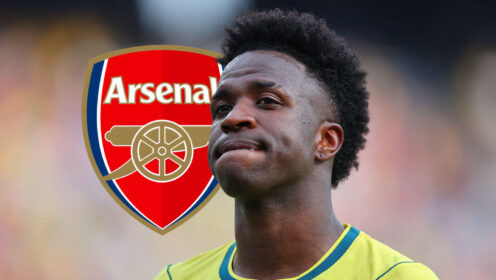
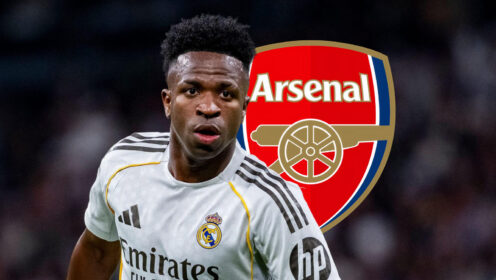
Would Vinicius Junior to Arsenal be the biggest signing in Premier League history? Top ten ranked

Would Vinicius Junior to Arsenal be the biggest signing in Premier League history? We have ranked the current top ten and come to a conclusion.
Yes. Yes it would. It’d be bloody massive. Even more so than these transformative deals.
10) Juan Sebastian Veron to Manchester United
“What we have done is bring in a really top player, one of the best players in the world. He is world class – a fantastic footballer.”
It admittedly isn’t the Sir Alex Ferguson quote about Veron which immediately comes to mind, but the Scot’s thoughts upon a British record transfer unveiling captured the mood of a happier, less Custis-tainted time at Manchester United.
After winning three consecutive Premier League titles, the manager sensed that the team had reached “a point when they have to be challenged”. It had been almost two years since Mikael Silvestre joined as their most recent outfield signing, so it was no surprise that “everyone sat up in the dressing room” when Veron arrived.
As Mike Phelan later recounted: “He walked across and the training session stopped. All the players were like, ‘Wow, it’s Veron!’ – Scholes, Giggs, Keane, the lot. They all shook his hand. He made such an impact.”
Not on the actual pitch, of course. Ferguson never mastered how best to deploy Veron’s skillset – particularly not in conjunction with the more naturally imposing Roy Keane – and so a “f**king great player” was seen only in fits and bursts at Old Trafford before he left for Chelsea.
9) Sol Campbell to Arsenal
As the story goes, Campbell wanted desperately to win the Premier League title at White Hart Lane, so he went to Arsenal.
There was a stratospheric contract offer on the table from Barcelona, interest from Inter and talk of moves to Real Madrid, Bayern Munich or Liverpool. But it was Arsenal who, after a series of covert midnight talks in David Dein’s garden for fear of the great defection being leaked, completed the coup of the century.
Even without the context of Campbell crossing the bitter north London rivalry, it was a gargantuan moment. One of the best defenders in the Premier League moving up the ladder to join a title challenger for free marked a significant shift in the power dynamic for a number of clubs.
“There were literally gasps. The media were so surprised,” said Arsenal’s senior media officer, charged with assembling a press convinced they were attending the grand presentation of £6m Richard Wright.
8) Andriy Shevchenko to Chelsea
The middle portion of one of the great palindromic playing careers felt fated for some time. Shevchenko became the gilded itch that an obsessed Roman Abramovich had to scratch, no matter the cost.
Chelsea were first linked in that wonderfully eclectic first post-takeover summer of 2003. The speculation persisted the following year, with the owner’s personal desire cited as the overriding factor. Then in 2005, even after Shevchenko’s great humiliation at the hands and jelly legs of Jerzy Dudek, Milan felt compelled to reject a world-record offer for their talisman.
It was still massive – a British record signing – when Chelsea’s persistence finally paid off 12 months later. It cost them £30.8m, an absurd amount of wages, and basically the first reign of Jose Mourinho.
Shevchenko remains the player to make his Premier League debut after winning the Ballon d’Or. It is the presumed perennial frustration of Vinicius that even if he joins Arsenal, that won’t change.
7) Angel di Maria to Manchester United
The “complete fanny” who probably still wakes up in cold sweats at the thought of the poor weather, “disgusting” food and “porcelain” women on offer in Manchester, never did quite acclimatise to life in England’s north west.
It was, in fairness, quite the cultural shift: Di Maria had spent the previous four years living in Madrid, then moved on from Old Trafford to Paris, Turin, Lisbon and his home city of Rosario.
And he perfectly summed up an era of lavish, ego-stroking, counter-productive opulence that Manchester United are only just putting behind them.
The man of the match in the most recent Champions League final was an atrocious fit under new manager Louis van Gaal; the Real Madrid regular must not have read his emails.
But at least, as Ed Woodward once gloated: “Di Maria saw a 12-times increase on Google searches on the day of his transfer from Real Madrid.” And that’s the real quiz.
6) Jurgen Klinsmann to Spurs
A Premier League side which had escaped relegation by a handful of points the previous season, signing a star of that summer’s World Cup ahead of numerous other suitors?
The ridiculousness of Spurs means that such preposterous history might well repeat itself more than three decades on, depending on the specific identity of Roberto de Zerbi’s “bomba” signing. The closest equivalent to Klinsmann in 1994 might be Harry Kane, which seems apt.
But really there is no clear parallel. Klinsmann was a world champion, a UEFA Cup winner with Inter and Bundesliga Golden Bootsman at Stuttgart, and “one of the best players in the world” in the eyes of manager Ossie Ardiles, joining a club provisionally docked 12 points and banned from playing in the FA Cup for the upcoming season.
Alan Sugar’s yacht and cappuccino-making skills can be persuasive.
5) Paul Pogba to Manchester United
For all the bloviating over the Premier League’s spending power, only twice since football was invented in 1992 have English sides broken the world transfer record.
Pogba, largely thanks to Paris Saint-Germain’s remarkable Neymar daftness a year later, might forever be the last.
It is fair to point out that Manchester United perhaps got caught up in the hysteria of proving they could, rather than spending any amount of time on whether they should. The very essence of beating Real Madrid to a player, of completing a transfer beyond the scope of Arsenal or Liverpool, became almost as important as Pogba himself.
Manchester United needed a statement, a marquee player, a vanity project, proof of their pulling power. There is immense regret at how it panned out ten years later, but it is still an achievement that they made it happen – at great expense – in the first place.
4) Mesut Ozil to Arsenal
Premier League signings from Real Madrid do not always work. But they absolutely come with a certain lustre, never more brilliant than when Arsenal infuriated Cristiano Ronaldo by snatching his chief assistant.
Ozil had been a fulcrum of the Real team for three season, making more than 50 appearances in each after earning a Bernabeu move by humbling Gareth Barry on the World Cup stage.
Yet in swooped Arsenal to shatter their transfer record and capture a genuine superstar.
After failing to procure Luis Suarez and Gonzalo Higuain that summer, Arsenal rebounded with a move which felt scarcely believable at the time (we christened him Mesut f***ing Ozil), their star having fallen.
Ozil never quite proved capable of lifting it back up, but a signing might never be celebrated quite so fervently outside a club’s stadium ever again.
3) Cristiano Ronaldo to Manchester United
Has an entire football club ever collectively exhibited such minuscule penis energy?
Ole Gunnar Solskjaer later admitted it was “probably a wrong choice” to bring Ronaldo back to Manchester United, but he was deployed in a charmless offensive also featuring Ferguson, Rio Ferdinand, Patrice Evra and Bruno Fernandes, designed specifically to appeal to the world’s most expensive and cumbersome narcissist.
Manchester United, in an actually decent state in the summer of 2021, sacrificed it all at the altar of Ronaldo, purely to drag him away from the Etihad.
A ridiculously embarrassing transfer was simultaneously absolutely colossal; the Ronaldo return was a Premier League pipedream for over a decade, realised more through panic than planning, but a substantial coup nonetheless.
In signing Ronaldo, Manchester United secured the biggest cult of all time. Sorry for the typo.
2) Alan Shearer to Newcastle
Sir Bobby Robson once said that he “told the board” to buy either Shearer or Ronaldo during his solitary season as manager at Camp Nou in 1996/97. The Barcelona chiefs promptly made the latter the most expensive player in the world, a title he regained 12 months later upon his subsequent move to Inter.
Shearer wrestled it away for a time as the filling to a Ronaldo sandwich when he turned Manchester United down for the final time to join Newcastle.
With inflation, the transfer was worth well over £200m in today’s money. It was a statement of farcical intent, a level of unprecedented investment that, as manager Kevin Keegan declared, proved “we are the biggest thinking team in Europe now”.
Not the best, of course; nothing was going to stop Newcastle collapsing to second behind Manchester United back then.
1) Robinho to Manchester City
“This is a real statement of intent as to the ambitions of this club,” said Mark Hughes.
“The biggest challenge was getting people to come to Manchester City. It was very, very difficult to get people to sign for the club at the time,” CEO Garry Cook added.
“During that week, we created a list of marquee players around the world and we tried to identify anyone we could bring to the football club because, if you don’t, the football club doesn’t get taken over.”
Robinho was the one who bit, burned by a sense he was no longer wanted at Real Madrid, and courted casually by Chelsea until Manchester City, fresh from their takeover hours earlier, forced the issue.
It was the deal which changed everything. Robinho never adjusted to the Premier League, but that was almost beyond the point. As a symbolic signing, mid-table Manchester City beating elite rivals to a Real Madrid player established them as a legitimate force and set the ball rolling for an era of dominance.